I am now two weeks back from Tucson, AZ and the MHI Annual Conference 2025, an outstanding event held at the JW Marriott Tucson.
I offered a Part 1 review and summary then (see Trip Report: MHI Annual Conference 2025) am back for Part 2 this week.
Gilmore Says.... |
 |
| Perhaps the best presentation of the conference was from former White House Security official Chris Finan, who told the sorry tale of our ever-growing cyber risks at companies and as a nation. |
 |
What do you say? |
|
| Click here to send us your comments |
| |
|
|
|
Don’t know the MHI Annual Conference? However, you are likely familiar with the major materials handling-oriented trade shows produced by MHI, ProMat in Chicago in odd numbered years, and MODEX in Atlanta in even years.
MHI, once known as the Material Handling Institute of America, is a trade association representing material handling companies of all sorts, from conveyor companies to fork truck providers to software firms and everything in between.
So the 800 or so attendees at the annual conference were dominated by representatives of these member companies.
But as I noted in Part 1, MHI is using a new strategy to try to get more “practitioners” to attend, with some success it appeared at the 2025 event.
This year’s conference certainly helped the cause. It was well organized, well executed, and with generally good content. And as an aside, the food was outstanding.
With that somewhat repeat from Part 1 covered, I attended a keynote on the state of the economy – both generally and for the material handling sector - from long-time MHI parter economist Jason Schenker, CEO of Prestige Economics. Schenker presents at every MHI conference, and he is entertaining, as well as claiming most years recognition for his forecasting accuracy.
He covered a lot of ground but is modestly bullish on both the overall and MHE economies. He also does not believe AI will result in huge numbers of lost jobs, though of course some types of job categories will take big hits.
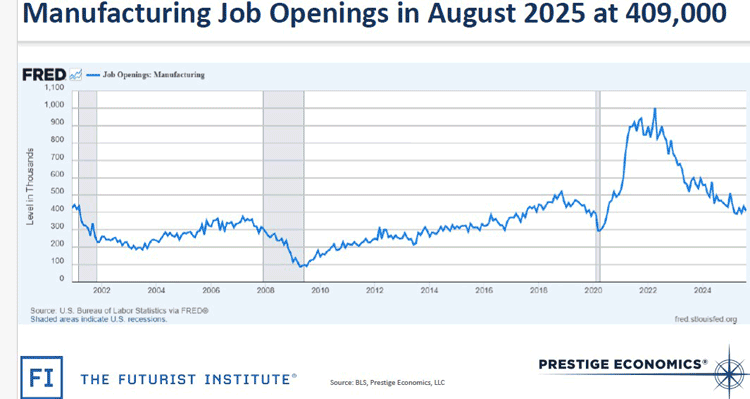
I include two slides from his excellent presentation. The first shows that despite a recent decline, there are still lots of manufacturing jobs, with 409,000 openings in the US as of August:
The second chart shows data from Schenker on recent past and forecasted orders and shipments of MHE.
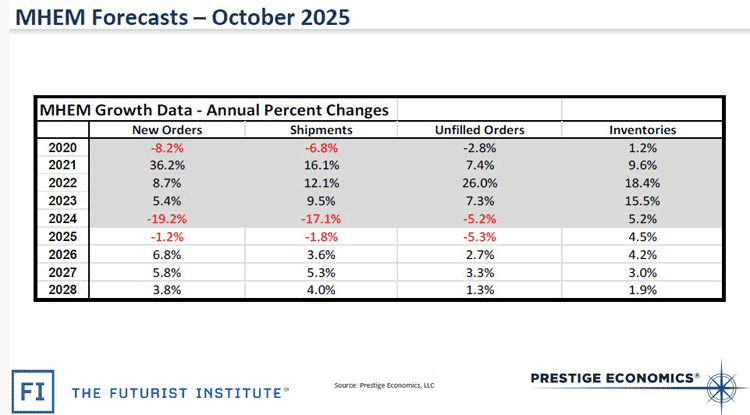
As can be seen, the projection is that MHE orders will fall 1.2% this year versus 2024, but will rise a solid 6.8% in 2026, followed by 5.8% growth in 20027.
I plan on being at the 2026 MHE Conference and let you know how on the mark these numbers are.
I’ll wind down here with some quick takes on other (mostly keynote) sessions I attended this year.
I wasn’t that wild about the keynote interview with former United Airlines CEO Oscar Munoz, who told the story of how he turned around the ailing air carrier.
The main point - listen to the troops, white collar and blue collar – is hardly new insight. Munoz is a good speaker – and led the turnaround with a transplanted heart – but his story didn’t resonate with me.
I did not make it but wish I could have made a session on “The Untapped Potential of Autistic Adults” by Theresa May of Aspiritech, but may look at this topic for SCDigest before long.
Thomas Goldsby of the University of Tennessee delivered an interesting presentation that focused around his view of the difference between supply chain resilience and agility, saying resilience is more about bulking up – inventory, capacity – while agility is more about process.
The agile supply chain can enable a company to gain share and profits during a disruption, Goldsby believes.
Perhaps the best presentation of the conference was from former White House Security official Chris Finan, who told the sorry tale of our ever-growing cyber risks at companies and as a nation.
It’s hard to know what to do, but Washington clearly needs to take more action, Finan convincingly argued.
Erica Dhawan, author and consultant, gave a keynote on “Connected Intelligence,’ which had to do collaboration with co-workers and others to get better answers and insight than we can on our own. That included an interesting anecdote of a CPG company that had a production problem they couldn’t solve with their team of PhD chemists.
But someone took the problem to an outside team of physicists, who solved it by looking at it a different way.
Dhawan presentation was OK, but mostly summarized principles we know but often forget, such as tips on preventing the usual 2-3 people dominating a meeting discussion.
The MHI conference was a real winner in 2025. My only wish is that more of the keynote presenters be on supply chain topics.
But I will certainly be back in 2026.
What is your take on this trip report? Let us know your thoughts at the Feedback button below.
Your Comments/Feedback
|