Search
or Search by TOPIC
Signup Bookmark page Sitemap  
 
  Sign-Up Free Newsletter
 
  Top Stories
Supply Chain News: Who has the Top Retail Industry Supply Chains for 2008?
Supply Chain Comment: It was a Wal-Mart Christmas
This Week's Supply Chain by the Numbers - Holiday Shipping, Holiday Sales, Ocean Shipping


  Sourcing and Procurement Focus: Our Weekly Feature Article on Topics of Interest to Sourcing and Procurement Professionals or Related Supply Chain Functions  
 
 
  - April 30, 2008 -  

Procurement and Sourcing: The Child Labor Dilemma in Low-Cost Country Sourcing


Despite Sourcing Policies and Local Laws, Child Labor is Key Input to Many Globally Sourced Goods; Ethical Problem – or Needed Source of Family Income?


SCDigest Editorial Staff

SCDigest Says:
While no one is in favor of child labor in a general sense, the scenario is not as clean as various corporate ethics policies may make it seem.

As watchdog group pressure continues to be strong on the offshore supply chains of Western companies in terms of environmental issues (see Will Environmental Groups Target Western Companies over Pollution Issues in Chinese Manufacturing?) and “Fair Trade” labor pay and conditions, many of these Western companies may unknowingly be dependent, in part, on child labor to produce their products, especially in the agricultural sector.

What to do about it? That’s a tougher question.

A few weeks ago, a Forbes magazine cover story said there was more child labor involved in offshore countries than many Western companies realize – or, in some cases, probably they would just prefer not to know.

“Every time you buy an imported handmade carpet, an embroidered pair of jeans, a beaded purse, a decorated box or a soccer ball, there's a good chance you're acquiring something fashioned by a child,” the Forbes article noted. “Such goods are available in places like GapKids, Macy's, ABC Carpet & Home, Ikea, Lowe's and Home Depot.”

But, while no one is in favor of child labor in a general sense, the scenario is not as clean as various corporate ethics policies may make it seem. The 20 cents per hour a child laborer may earn working in the agricultural sector in India can be an important contribution to a family income that is barely enough to keep a subsistence lifestyle. Take it away, and the family falls into deeper poverty.

Laws in most low-cost countries prohibit child labor (generally defined as under the age of 14), with some exceptions in the agricultural sector. But local authorities often look the other way. That means an 11-year old child may be working long hours in an Indian cotton field to harvest a crop that eventually finds its way into a t-shirt on a major US retail chain’s shelf.

The UN International Labor Organization estimates that 7 out of 10 child laborers today work in the agricultural sector, versus just 9% in manufacturing, as greater focus and enforcement in the past 15 years has greatly reduced the number of kids toiling in factories in Asia and elsewhere.

(Sourcing and Procurement Article - Continued Below)


Category Sponsor:


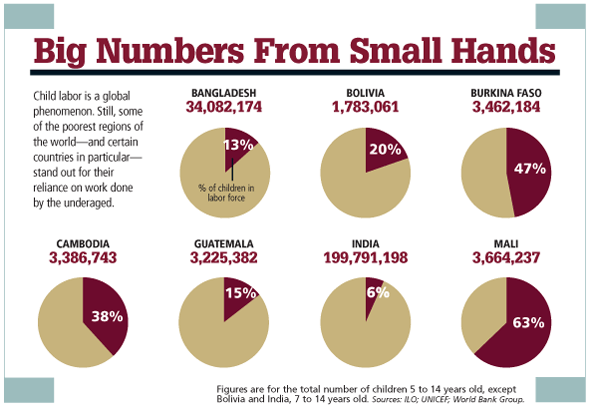
Still, there are more than 200 million child laborers around the globe, the UN estimates, with especially high number in some Asian and African countries, as shown in the graphic below.


Source: Forbes Magazine

In some cases, low-cost country suppliers say that the relentless pressure by Western companies to buy at lower costs sometimes means they have no choice but to use child labor in order to meet required price points. The alternative: lose the business, throwing the parents out of work as well.

Last October, a New Delhi labor rights group called Global March Against Child Labor tipped off a British newspaper that more than a dozen kids were working 16 hours a day at a subcontractor embroidering blouses for a prime vendor of GapKids.

After the paper ran the story, The Gap, forced the firing of the subcontractor and placed the prime vendor on probation. The chain’s buyers also met with other suppliers to reiterate its zero tolerance policy on child labor.

But agriculture is even harder to deal with than manufacturing, in part because of the more complex supply chain connections between the products produced with child labor and the ultimate consumer products that use these farm goods.

What is really best for the local families is also often murky. As the Forbes articles notes, many “labor organizations can't agree on how to ameliorate the situation. Some say that children of poor families have to work in order to make ends meet and that the government should offer them night classes to prepare them for better jobs.”

How big a problem do you think child labor may be in the low-cost country supply chain? Should Western companies have a zero tolerance policy? Or are the dynamics, especially in the agricultural sector, more complicated than that? Let us know your thoughts at the Feedback button below.


Send an Email
   
 
Feedback
No Feedback on this article yet.
     
 
Related Videos Related News & Videos
Coming soon
Supply Chain News: Who are the Top Procurement Outsourcing Vendors?
Black Book of Procurement Outsourcing 2008
Supply Chain News: Procurement Outsourcing to Enjoy Rapid Growth, 2008 Black Book of Outsourcing Authors Say
Supply Chain Comment: Speculation Must Have Played a Role in Oil and Commodity Pricing
Supply Chain News: Another Survey Picks on Procurement Function
Supply Chain Graphic of the Week - Asia Procurement Organizational Structure
   
Keywords
Procurement/Supplier Management   Procurement/Supplier Management


Supply Chain Digest Home | Contact Us | Advertise With Us | Sitemap
© 2006-2007 Supply Chain Digest - All Rights Reserved
close
Close
Featured SCDigest Content
Videocast: Mastering Lumpy Demand
Jan 15, 2009
 
How to Beat the Problem of Lumpy Demand,
Improve Forecasting and Optimize Inventories
Excellent Videocast. Click below to learn more or to register. Can't make date? Register now to receive on-demand link.
Register Now!