Search
or Search by TOPIC
Signup Bookmark page Sitemap  
 
  Sign-Up Free Newsletter
 
  Top Stories
Supply Chain News: Who has the Top Retail Industry Supply Chains for 2008?
Supply Chain Comment: It was a Wal-Mart Christmas
This Week's Supply Chain by the Numbers - Holiday Shipping, Holiday Sales, Ocean Shipping


  Sourcing and Procurement Focus: Our Weekly Feature Article on Topics of Interest to Sourcing and Procurement Professionals or Related Supply Chain Functions  
 
 
  - March 17, 2008 -  

Procurement and Sourcing News: As Corporate Buyers Battle Rising Commodity Prices across the Board, is the Common Factor a Falling US Dollar?


Rising Global Demand May be a Factor, but Graphs Seem to Show the Real Driver is a Falling Greenback


SCDigest Editorial Staff

SCDigest Says:
It’s hard not to draw the conclusion that the falling dollar is driving the rise in both oil prices and other commodities. The similarity of the graph trajectories is remarkable. 
What do you say? Click Here to Send Us Your Comments

Supply managers and entire corporations have been battling rising commodity prices for the past two-plus years or more. The incredible rise in oil prices is an almost daily headline. Metal prices continue to maintain historically elevated levels. More recently, the term “Agflation” has been coined to describe the substantial rise in the price of commodities ranging from corn to wheat.

Of course, when first level commodities rise, that then drives price increases in secondary commodities: oil price increases drive plastic resin prices higher; rising corn prices lead to increasing corn syrup prices; higher iron ore prices lead to higher steel prices, etc.

What is causing this rise in commodity prices that is wreaking havoc on corporate profitability?

Pundits have cited many factors. The number 1 culprit cited is often rising commodity demand in China, India and other developing countries. The growing ethanol industry is seen as the cause of rising corn prices, and sometimes other agricultural goods, as more production is moved to corn. Constrained supply markets are also often cited for other commodities, such as iron ore.

But is the real answer the falling US dollar?

In a recent column for The American Entrepreneur newsletter, Michael K. Kauffelt of investment firm Bill Few Associates makes a strong case that right now the falling US dollar is enemy number 1.

(Sourcing and Procurement Article - Continued Below)


Category Sponsor:


Graphs Tell the Story

The graphic below tells an interesting story. Over the same time frame (basically, the past 12 months), the three charts illustrate: (1) the fall of the US dollar (shown by the rise in the value of the Euro versus the dollar); (2) the rise in crude oil prices; (3) and the rise in a broad basket of commodity prices as represented by the Morgan Stanley commodity index.
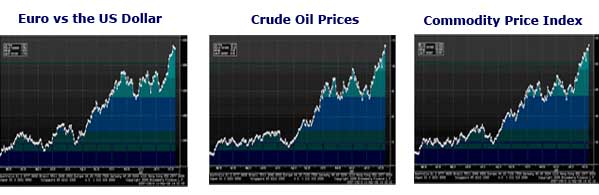
It’s hard not to draw the conclusion that the falling dollar is driving the rise in both oil prices and other commodities. The similarity of the graph trajectories is remarkable.

“I think that many investors and speculators are investing in commodities in order to hedge against the falling dollar and not necessarily because they participate directly in the commodity markets as a consumer or supplier of the underlying commodity,” Kauffelt wrote.

On a related note, a Wall Street Journal editorial this week noted that “strong world growth explains part of the commodity price this decade. But the dollar price of oil has surged by some 60% since September, even as US growth has slowed sharply.”

Both Kauffelt and the Journal also note the investors and speculators are driving commodity prices up as they flee dollar-based investments (bonds, etc.) to investments in “harder” assets such as metals and other commodities.

While supply managers have always had interest in the value of the dollar as it pertains to the net cost of goods that can be sourced around the world, increasingly, it appears the link between the dollar and commodity inflation needs to be better understood.

Is the falling dollar the key driver behind recent commodity inflation? Or are the charts just a coincidence? Let us know your thoughts at the Feedback button below.


Send an Email
 
Feedback
No Feedback on this article yet.
     
 
Related Videos Related News & Videos
Coming soon
Supply Chain Graphic of the Week - Understanding Supply Chain Network Cost Curves
Supply Chain News: Who are the Top Procurement Outsourcing Vendors?
Black Book of Procurement Outsourcing 2008
Supply Chain News: Procurement Outsourcing to Enjoy Rapid Growth, 2008 Black Book of Outsourcing Authors Say
Supply Chain Comment: Speculation Must Have Played a Role in Oil and Commodity Pricing
Supply Chain News: Another Survey Picks on Procurement Function
   
Keywords
Procurement/Supplier Management   Supply chain costs   Procurement/Supplier Management   Supply chain costs


Supply Chain Digest Home | Contact Us | Advertise With Us | Sitemap
© 2006-2007 Supply Chain Digest - All Rights Reserved
close
Close
Featured SCDigest Content
Videocast: Mastering Lumpy Demand
Jan 15, 2009
 
How to Beat the Problem of Lumpy Demand,
Improve Forecasting and Optimize Inventories
Excellent Videocast. Click below to learn more or to register. Can't make date? Register now to receive on-demand link.
Register Now!