July
22, 2004
|
 |
|
 |
|
|
  |
|
|
|
   |
 |
|
| |
Dan Gilmore
Editor-in-Chief |
|
|
|
We regularly
talk about things in this newsletter that others just
won’t, and here’s another one. Prices for
most supply chain software applications, from a vendor
perspective, are in the toilet. Almost incredibly so.
Virtually every supply chain planning and execution
vendor with whom I’ve recently spoken laments
the price erosion that they have experienced over the
past few years. What’s going on? Several things.
Of course, it’s fundamentally about supply and
demand. Capital budgets for IT are simply lower for
many companies, especially for new software. In total,
there have just been too few deals to go around, and
vendors have often been very aggressive trying to win
available business. Because the marginal cost of delivering
a software app is almost zero (burn the CD), and there
are other, very substantial dollars that each software
sale drags through (maintenance, implementation services),
vendors will get very aggressive on license pricing
in such a market.
Relatedly, the whole corporate mindset has changed about
buying technology. Most corporations are just much more
cautious about buying technology today, and have become
better negotiators. The extreme ROI focus of the past
few years has also had the effect of pushing down prices
because corporate demands for expected return on investment
keep going up.
The efforts of ERP vendors to get in the supply chain
software game have also had an effect. ERP providers
have sometimes offered to “give away” their
supply chain modules as they try to gain some market
presence. Absent that, from a pure software license
perspective, ERP applications sell at prices below “best
of breed” levels. That also tends to move overall
market prices further south.
Finally, the vendors themselves have often contributed
to their own situation, especially in supply chain execution
deals (WMS, TMS). In an increasing number of deals,
the losing vendor has “gone nuclear,” offering
to give the license away, or close to it, if they feel
they are losing the deal. This strategy rarely results
in a win, but usually drives down the winner’s
price, and ultimately undermines the entire market pricing
level.
So, is this a good thing for companies buying software,
a bonanza something like OPEC dropping oil prices to
$16 a barrel? Well, yes and no. I am reminded
of something I learned about back in college, the so-called
“Tragedy of the Commons.” In general, the
notion was that while having an open commons for animals
to graze was a good thing for an individual farmer,
across the community it was a bad thing, because with
everyone taking advantage of the opportunity the commons
itself was ultimately destroyed. In the end, everyone
lost.
I think there are some parallels here. It’s great
in the short term for any one company to get a low price
on software, but collectively it makes it very hard
for the vendors to make a profit, innovate with new
solutions, and provide quality service and support.
So, what should you do? Well, I may be a little controversial
here, but I think you should negotiate hard but still
make the deal a win-win for your chosen vendor. Don’t
drive down the price to the point where the deal is
just plain “ugly,” as the vendors like to
say. The reality is that giving the vendor a reasonable
price for their solution upfront has a very marginal
impact in the total cost of ownership of the system
over it’s life.
Of course, that’s easy to say when it’s
not my money. And if an outstanding, even outrageous
deal simply drops in your lap, I guess you should just
take the savings and run.
Is it good practice to have some level of “win-win”
price negotiation philosophy with software vendors?
Or should you simply drive down the price to the lowest
level you can get? Let
us know your thoughts.
|
|
 |
|
|
 |
| |
|
This
Week:
Microsoft
Ready to Jump on RFID Bandwagon
Court
Strikes Down Hours of Service Rules
Slowdown
in China Causes Steep Drop in Ocean Shipping Rates
Summary
and comment below. |
| |
|
| |
Supply
Chain Investment News
Gainers
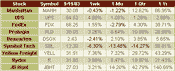
outnumbered losers 7 to 3 for our Transportation,
Logistics and 3PL Providers. Our biggest gainer
was Descartes, up 7.6% for the week and 15.3%
for the past month. Our biggest loser was Vastera,
down 6.8%.
|
| |
|
| |
Click
here to see performance over the past week, month,
quarter and year >> |
| |
|
| |
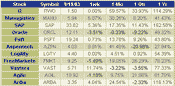
Our Supply Chain providers had a down
week on Wall Street, with all but one stock
in negative territory. Aspentech suffered
the worst loss, losing more than 21% of
its value. The one bright spot was Peoplesoft,
up nearly 4%.
|
| |
 |
| |
Click
here to see performance over the past week, month,
quarter and year >> |
|
|
 |
|
|
UPS
Logistics is the largest U.S. based third party
logistics company. What company is the second
largest U.S.-based provider?
Answer below |
|
|
 |
|
|
Well,
we certainly generated a significant amount of
feedback on last week’s First Thoughts column
on the value (or lack thereof) of using the weighted
average method to select between potential vendor
options for technology, consulting, 3PLs, etc.
Our Feedback
of the Week is a great letter from Jim Duarte
of Anheuser-Busch. There’s also a thoughtful
response from our friend John Hill of ESYNC (a
strong runner up for feedback of the week), and
writers on this topic from Dell, Tompkins Associates,
and AT Kearney. We’d love some more responses
on this subject from our readers.
We had some letters on other topics as well, but
we’ll save those for next week.
For more complete comments from readers, click
here.
Keep the dialog going! Give us your thoughts on
this week’s Supply Chain topics.
feedback@scdigest.com. |
|
|
|
|
|
| |
|
|
|
Microsoft
continues aggressive efforts at least on the marketing
front with RFID, as noted in an article in Information
Week, with plans to add “RFID support” to
its mid-market ERP applications (Navision, Axapta).
It has a potential interest in putting some version
of Windows in every RFID reader (surprise), believing
it might be able to drive down the cost of readers as
a result. The software giant is also doing a lot of
research and made some vague comments about creating
low cost RFID infrastructure in several Microsoft products.
Because of its clout, Microsoft of course has been able
to get a large number of vendors to participate in its
RFID Council, formed in April.
What bothers me in many of these kinds of articles though,
is that it doesn’t go into any level of detail.
It notes Microsoft is adding RFID support to its Axapta
product. What does that really mean? And how is Microsoft
really going to drive RFID systems prices down, and
make implementation easier? The possibility is posed,
but the “how” part is conveniently left
out. Kudos to the Microsoft public relations group.
This isn’t at all anti-Microsoft, and I think
they absolutely should be jumping on the RFID bandwagon.
It’s just part of my growing frustration at the
lack of real facts and detail in many of these reports
and articles. Also frustration at the notion, promoted
not only by Microsoft but also to some extent, several
of the big consulting firms, that the challenge of RFID
has mostly to do with the “plumbing” –
data management, integration, adding RFID fields to
databases.
I’m not minimizing that work, in many cases, but
let’s be real. The challenge (and opportunity)
is for someone to really figure out how to use RFID
data to drive out costs or increase revenues, which
means changes to planning and execution applications
to create real value. Forgetting Wal-Mart for a second,
if all this hullabaloo is just to eliminate some bar
code scans in receiving and shipping, we’ve all
got our priorities mixed up.
There’s one thing in here that does make some
sense, which is the suggestion that Microsoft could
play a lead role in developing standards of how data
is communicated from RFID readers. But understand that
RFID data processing intelligence will increasingly
move into the hardware itself – today’s
RFID “middleware” has a very short lifespan.
What role do you see Microsoft playing in the RFID market?
Do you agree or disagree that all this RFID plumbing
is secondary to finding how planning and execution apps
will really be changed to increase value/reduce costs
from RFID data? Why do almost all articles on RFID leave
out any real detail that could be useful? Let us know
your thoughts.

|
 |
 |
|
|
On July 16th, a federal
circuit court in Washington D.C. struck down the new
driver Hours of Service (HOS) rules, citing concerns
and existing law around protecting driver health. (The
actual court opinion is available on the link above.).
The court ordered the Federal Motor Carrier Safety Administration
to review the rules in light of its concerns. The rules
are still in effect during this review.
For it’s part, the FMCSA released the following
statement:
“The Department of Transportation and the Federal
Motor Carrier Safety Administration (FMCSA) have received
the court's decision. With assistance from the Department
of Justice, we are currently reviewing the opinion to
determine possible next steps.
Under the court's rules of procedure, the Department
has 45 days to review the decision and decide whether
to seek other legal remedies. During that period of
time, the current hours of service rule, announced in
April, 2003, remains in effect.
FMCSA will advise Federal authorities and State law
enforcement partners of their responsibility to continue
compliance with the current rule. FMCSA will advise
major industry associations to educate motor carriers
and drivers of the continued need for HOS compliance.
The Hours of Service rule is important to commercial
vehicle safety and is the first major re-write of the
HOS rules in more than 60 years.”
The ruling made the Teamsters happy: “This is
a victory for all truck drivers, including Teamsters,”
said Jim Hoffa, Teamsters General President. “Working
behind the wheel of a truck is hard, and our concern
with this set of rules was that they would increase
driver fatigue. We know fatigue creates danger on the
highways.”
So what does this all mean? I’m not sure, other
than it seems at least reasonably likely that the HOS
rules will be further tightened a bit to meet these
concerns, causing more havoc and confusion, and maybe
really having an impact in carrier costs that will be
reflected in rates.
Do you expect the ruling and pressure from the Teamsters
and consumer group to further tighten hours of service
requirements? What impact do you think this will have
on drivers and rates? Let us know your thoughts.
|
|
|
|
A Wall Street Journal article last
week noted that there has been a substantial reduction
in ocean shipping rates over the past few months, as
strategies intentionally designed by the Chinese government
to slow down economic growth have eased the demand side
of the equation.
As the article notes: “Prices of shipping goods
via ocean-going vessels are 30% lower than their record
in February, and while they have inched higher during
the past couple of weeks, some economists predict that
they still will be significantly below February levels
by year end.”
That’s good news for shippers after substantial
rate increases over the past two years. The cause: “In
late April, the Chinese government imposed lending curbs
on businesses in an effort to slow the growth of industries
it believed were expanding too rapidly. As a result,
demand for a wide variety of imported commodities declined,
freeing up vessels that had been in heavy demand.”
Of course, as with all such changes, there are many
impacts on the economy and supply chains. For example:
 |
Lower shipping costs
means offshore production/global sourcing becomes
even more economically attractive |
|
Conversely,
U.S. exports become more competitive |
|
Lower logistics
costs reduce nascent U.S. inflationary pressures |
The article also notes that a number of shipping companies,
responding to the generally growing demand, are bringing
new vessels on-line in the next two years, which should
swing the demand-supply equation more in favor of shippers.
However, other long-term trends point to steadily increasing
ocean rates.
As always, we can’t provide a link to Wall Street
Journal story, but we’re happy to email you a
copy upon request.
Do you expect ocean rates to continue their overall
climb, or moderate over the next few years? How will
this impact off-shoring decisions? Let us know your
thoughts.
|
|
|
|
|
| |
|
|
|
Two quick
points:
First, you wrote: "The ratings (say a scale of
1-5 for each category) don't really reflect the differences
in vendors. Is a vendor that receives a 4 really twice
as good in that category as one which gets a 2? That's
how the math comes out."
Doesn't fly statistically...ever! The 1-5 scale
is ordinal so there is no math. There is no
mean/average for ordinal data. The only calculation
is "what percent fell in each category". People
continually show their ignorance of statistics by treating
a 1-5 scale as interval data when it isn't. [Editors
note: that was the point we were trying to make, perhaps
not effectively].
Second, the "best of breed" method usually
narrows the topic so finely that software that has a
broad spectrum of solutions never wins; e.g., SAS. The
"best of breed" philosophy merely increases
the size of the empire because one needs a software
expert for functionality, a integration expert to get
all the "best of breeds" to talk to each other,
and a technical expert to keep the software working.
Multiply that times the number of "best of breed"
solutions and you have an IT empire filled with complexity.
Integrated packages take fewer human resources and that
scares "empire builders."
I agree that weighted averages are just a tool to make
one think that a subjective practice has become objective.
Jim Duarte
Anheuser Busch Companies, Inc. |
|
|
|
|
Great issue.
Wish I had the time to comment on more than one part
of it. On "Weighted Averages" (WA), I searched
Mr. Hubbard's website, but couldn't find further elaboration
on his alternative. At a high level, I completely agree
with the two of you on the assessment. Like most things,
the "WA" approach as the sole arbiter for
supplier selection is at best naive and dangerous.
On the other hand, it can add value to the process if
positioned and understood to be only a component
of a larger Selection Toolkit that includes:
1. A requirement for detailed narrative responses from
suppliers as to how their packages will meet specific
client requirements;
2. Thorough reference checks;
3. Client-specific software demonstrations and in-depth
analyses;
4. Visits to relevant installed system sites
with supplier finalists.
How does "WA" add value?
First, rating requirements to the decimal point, creating
spider graph comparisons and the like are foolhardy.
Second, given the foregoing, with an experienced hand
facilitating the assembly and ranking of the elements
to be rated, the process forces stakeholders to articulate
their needs and weigh/value them. Admittedly, recommended
weighting will be driven by team member bias, but that's
where the "experienced hand" comes in, challenging
and balancing disparate inputs and driving towards consensus.
We recommend that initial preparation of this document
precede and serve as a basis for the RFP. Among other
things, it provides a handy checklist for assuring RFP
integrity. As the document evolves, key questions to
be asked include "what are the implications of
not having _____?" and "what are the risks
associated with a failure of this component or functional
module?".
Third, a well-prepared WA document, coupled with line-by-line
review of RFP responses can serve as a useful device
for narrowing the field of suppliers to two or, at most,
three finalists.
Fourth, the "WA" can be used to assure the
completeness of the document used for defining scenarios
to be addressed during the software demos.
Fifth, the WA can serve as a guide/checklist for site
visits and during final evaluation and selection.
Finally (although I could list several more attributes),
the WA process builds stakeholder ownership that, as
you know, will be critical throughout the project.
One final thought: The keys to successful use of the
"WA" are in its construct and positioning
as a component of the selection process.
John Hill
ESYNC
As a project
manager I deal with these decisions many times throughout
the year for both hardware and software system purchases.
I agree that the weighted average is flawed as it is
used as a tool to justify the vendor you want, not necessarily
the best for the project. As cost is usually the most
important factor in the decision, I use this as a base
line, then do a reverse validation on the low cost vendor.
Basically it comes down to trying to create the argument
to select the next highest cost supplier. Is there any
justification to bridge the delta? If the answer is
yes then you present the facts.
Brian C Finch
Dell
Three simple
thoughts to address your shortcomings:
|
Take price (more appropriately
total cost) out of the equation and plot the qualitative
evaluation against cost; after all there is often
a trade-off |
|
Can't
we be disciplined just once? Are we not picking
the right people to do the evaluation? |
|
Are we
not capable of knowing what we want and designing
a set of metrics to drive to the answer? |
· [The teams sited] seem unprofessional, undisciplined
and poorly guided.
Paul Inglis
A.T. Kearney
Great article! I'm passing this
along to clients and business partners. I can't wait
to see what others see as "better" options...
Keep these great nuggets of wisdom coming.
David Meyers
Tompkins Associates
|
|
|
|
|
| |
|
|
| Q. |
UPS Logistics
is the largest U.S. based third party logistics
company. What company is the second largest U.S.-based
provider?
|
| A. |
CH Robinson,
per Armstrong Associates ranking of global 3PLs
by 2003 revenues. CH Robinson, was #10 on the
list, at $3.6 bilion in revenue, behind UPS at
#8 and just ahead of #11 Menlo Logistics.
|
|
|
|
|
|
|