| March
17, 2005 |
 |
|
| 
|
 |
 |
|
|
|
|
| |

How
Cooking.com
Reduced
Inventory Costs & Replenishment Planning Time
Cooking.com,
a leading online retailer of cookware reduced their
inventory costs by 35% and replenishment planning time
by 75% using CatalystConnect™ Demand Management
software.

Join this
FREE webinar to hear Cooking.com’s project case
study and how they implemented the system in less than
three weeks and received a ROI in less than 90 days!
Click
here to register!
|
|
|
|
|
|
| |
This week's open opportunity is:
Aftermarket Inventory Manager
For a leading Chicago area manufacturer
Click
here for the full job description.
Click
here if you are an interested candidate.
(NOTE: Any inquiries will be handled with complete confidentiality.)
|
|
|
|
|
|
| |

Download the reports to improve your
evaluation and selection process!
|
 |
|
|
| |
| Archived Recordings: |
|
Understanding RFID Middleware
and Infrastructure Technology |
|
Understanding RFID Hardware and Solution
Deployment Options |
|
| View
Detailed Session Description |
| |
|
|
 |
|
|
|
|
|
   |
 |
|
| |
Dan Gilmore
Editor-in-Chief |
|
|
|
What is your process for dealing with future demand?
Forecasting? Demand Planning? Demand management?
Triggering this question was a call last week from an
SCDigest reader looking for a new forecasting system.
That’s really what she wanted – a statistic
tool to help project future demand.
After our conversation, I pulled down from the shelf
Demand Management Best Practices: Process, Principles,
and Collaboration, the book from Oliver Wight consultants
Colleen Crum and George Palmatier, co-published with
APICS in 2003. It’s a must read for anyone involved
in forecasting – and highly beneficial for those
in other supply chain functions, or in sales and marketing.
The general process of forecasting, of course, is almost
by definition fraught with error. The desire to escape
the supply chain miseries caused by poor forecasts are
in part behind the drive for “demand-driven”
supply chains, strategies of moving from make-to-stock
to make-to-order, the promise of RFID, etc.
The thrust of Crum and Palmatier’s book, however,
is that forecasting – especially statistical forecasting
– is really only one part of the demand management
process. In a nutshell, forecasting is about predicting
demand; demand management is influencing demand, and
ensuring that the key functional areas of the company
are tightly integrated with executing against that plan.
Last year, SCDigest printed released a report, Sales
and Operations Planning in Complex Discrete Manufacturers
- A Research Report on Challenges and Opportunities,
based on a survey of several dozen companies. We found,
for example, that while the vast majority of companies
said they had formal Sales and Operations Planning (S&OP)
processes, only 15% of them said those processes were
highly integrated within their organizations. (Click
here for graphic.) I find this data is supported
consistently by my anecdotal conversations with supply
chain managers.
There are a number of important observations related
to this in the book. Just a few of those I think are
worth sharing include:
|
Forecasting should be about future
demand, not future shipments.
History-based forecasting techniques almost always
deal at the shipment level, since that is the data
available. That may or may not accurately reflect
true customer demand patterns. |
|
The tendency to focus on shipments rather than
true demand is often exacerbated by having the demand
planning function housed within the supply chain
group, which tends to think inherently in these
terms: �In our experience,� the authors write, �it
is not unusual for the demand forecast to be biased
toward the supply organization�s ability to produce
and deliver.� |
 |
Demand management is all about coupling true market
demand with the potential for capturing a given
share of that demand, and then agreeing on a plan
(based on financial and strategic imperatives) that
will be used as the basis for tactical execution
activities across sales, marketing and the supply
chain functions. The paradigm changes from responding
to demand to influencing demand consistent
with the company�s goals and objectives. |
|
While this integrated process (captured largely
but not completely in the concept of Sales and Operations
Planning) will substantially improve the results,
forecast inaccuracy will still be present: things
change, competitors respond, etc. Companies must
therefore consistently tune those forecasts and
execution plans as those changes are understood.
|
|
I loved this quote from Albert Einstein: “All
models are wrong; some are useful.” |
So the question is, just how useful, really, is your
forecasting model? Where are you on the continuum from
forecasting to demand management? We talk – correctly
- so much in this industry about the need to integrate
and collaborate within the supply chain, and between
trading partners. My sense is that the opportunities
– and challenges – of integration between
the supply chain organization and sales and marketing
receive relatively little attention, despite some evidence
of a heightened interest in S&OP.
What do you think of the concept of “demand management?”
Clear goal, or academic pipe dream? What are the challenges
of getting there?
Let
us know your thoughts.

|
|
|
|
 |
|
|
 |
|
|
| |

By
Iván Pérez-Méndez,
Vice
President of Engineering,
Cadre
Technologies, Inc.
The technology
deployed in modern supply chains has improved the accuracy
and efficiency of orders, inventory, shipments and transactions.
But the final steps in successfully executing all those
logistics transactions, performed everyday by many thousands
of mobile warehouse workers, are typically relegated
to the lowest levels of technology and communications
– i.e. pencil and paper.
When you think about it, receiving, picking, replenishment
and other warehouse transactions are really the most
critical events. A pick is the seminal transaction that
transfers ownership from the warehouse (manufacturer
or distributor) to the consumer (direct ship or to retail).
When a product is removed from a location and added
to an order, it is no different than the consumer selecting
a product from the shelf as a buying decision. It is
the decision about what to select and the process of
selecting it.
Equipping mobile warehouse workers with the right tools
to execute to expectations has been a challenge for
many years. A Warehouse Management System (WMS) typically
prepares the work for the mobile warehouse worker. The
WMS tracks the location and attributes of product from
receipt to storage to picking to shipment.
The mobile warehouse worker receives and accepts incoming
shipments, puts away product in bulk areas, moves the
product from the bulk area to the order picking areas
(replenishment), picks orders, performs any value added
processing, checks inventory locations, and ships orders
... click
here for full column.
|
|
|
 |
|
| |
Where does the Food Manufacturing sector rank
in terms of size versus other U.S. sectors?
Answer below
|
|
|
 |
|
|
Feedback is coming in at a rate greater than we
can publish it – thanks for your response.
We received a number of letters on our First Thoughts
column on customer satisfaction – or more
notably the lack thereof in many organizations,
and how Angie at Dorothy Lane Market in Springboro,
OH makes a real difference. And how we need more
companies thinking like that. We publish a few
of those letters this week, including our feedback
of the week from Jan Jurcy of Avnet, who notes
what sounds like an interesting conference on
customer service held each year at Arizona State
University.
You’ll
find more letters on this topic (more next week
too), some additional letters on our “technologies
to watch” piece on use of linear induction
motors to move freight, and some pointed comments
on our summary of the Grocery Manufacturers Association
report questioning the ROI for CPG companies from
RFID.
For
the complete comments from readers, click
here.
Keep
the dialog going! Give us your thoughts on this
week's Supply Chain topics.
feedback@scdigest.com |
|
|
|
|
| |
|
|
View
Full i2 Article >>>
View
Full Manu Article >>>
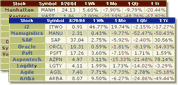
i2 and Manugistics must
be on the same wavelength. Last July, within a week
of each other, the two supply chain software innovators
each announced their CEOs (Sanjiv Sidhu and Greg Owens,
respectively) were giving up those spots, and would
retain just the chairman of the board role. i2 then
embarked on a CEP search; Manugistics announced at the
time of that news the hiring of software industry veteran
Joe Cowan as CEO.
Within a few days of each other at the end of February/beginning
of March, each company also announced some changes resulting
from those earlier moves.
Given the size of each company’s customer base,
and the essential role each has played in the growth
of not only the supply chain software industry but really
our thoughts about supply chain management generally,
we think it’s important to keep tabs more than
we normally do on individual vendor personnel and strategy
moves.
i2 announced that it has named Michael McGrath as its
new CEO. McGrath, who was on i2’s board, was one
of the founders of supply chain consultancy PRTM, known
for its strategic supply chain strategy work, and key
driver behind the development of the Supply Chain Operations
Reference Model (SCOR) standards. He had retired from
PRTM in 2004.
Meanwhile, Manugistics’ Cowan announced that the
company would be reorganized into four “specialized
business units”, focusing on: Retail, Consumer
Goods, Government and Revenue Management (Travel, Transportation
and Hospitality).
We haven’t had a chance to talk with either company
yet about these changes, and will leave it to the industry
analysts to give a detailed review. One, Steve Banker
at ARC, was impressed with Manugistics new strategy.
He wrote: “Manugistics has worked internally to
create supporting tenants or principles which support
the synchronized supply chain. The first three tenants,
(there are six overall) are:
1. The Supply Chain should be viewed not from an enterprise-centric
viewpoint, but from a community viewpoint
2. The overall goal of the community is consumer satisfaction
at the "moment of truth"
3. Companies that operate as good community members
will be more profitable then standalone enterprises.”
Our sense at SCDigest is that:
|
i2 needs a CEO that can take the strong
domain expertise and product power of i2 and actually
executive based on those strengths in the market
(and at the customer) in a more discipline fashion.
McGrath may be that person. |
|
Manugistics has had some focus issues over the
past few years. This structure will improve that
focus both at a product and industry level, and
more clearly show which areas are producing results
(and should receive stronger additional investment)
and which are not. |
As our ERP
versus best-of-breed supply chain software reports
indicated, customers are demanding that best-of-breed
leaders continue to innovate if they wish to compete
effectively with growing supply chain initiatives of
SAP and Oracle. Think both these changes will be positive
for that.
What do you think of the moves at i2 and Manugistics?
What does each have to do to improve its financial performance?
Let us know your thoughts.

|
 |
 |
|
|
Provocative cover story article in
this week’s Business Week magazine on the growing
trend of U.S. companies to not only outsource manufacturing,
but increasingly product design as well – and
how this strategy may create substantial risk to those
companies down the road.
It’s what BW calls “the next step in outsourcing
– of innovation itself. When Western corporations
began selling their factories and farming out manufacturing
in the 80s and 90s to boost efficiency and focus their
energies, most insisted all the important research and
development would remain in-house. But that pledge is
now passe’.”
As with manufacturing outsourcing, technology and electronic
companies are leading the way. A substantial amount
of the design in those industries is already outsourced
– it’s how Dell can have R&D expenditures
of less than 1% of sales in 2004. R&D spending as
a percent of sales is continuing to drop at most major
technology companies.
The article quotes Accenture’s Allen Delattre
as saying: “R&D is the single biggest remaining
controllable expense to work on. Companies will either
have to cut costs or increase R&D productivity."
The issue, the article suggests, is that R&D spending
is producing too few hit products or game-changing technology
to justify the expense.
It’s not just technology companies looking to
outsourcing design though – they are simply on
the leading edge. Boeing is partnering with an Indian
software company – not just outsourcing the programming
work – for a whole new generation of airplane
navigation and control systems.
It cuts cost in the short term, but is it smart business
in the long term? It’s too soon to know, but clearly
there are risks. Motorola, for example, used a Taiwanese
firm to co-develop cell phones – until that company
released its own brand into the Chinese market. Even
more critically, companies may in fact “lose their
souls,” and begin ultimately a descent into oblivion
by losing control of what makes them competitive. As
Frank Armbrecht of the Industrial Research Institute
is quoted as saying, “Companies realize if they
want a sustainable competitive advantage, they will
not get it from [design] outsourcing.”
But the article makes it clear that belief may be slipping.
“Wherever companies draw the line, there’s
no question that the demarcation between mission-critical
R&D and commodity work is sliding year by year.”
Outsourcing truly commodity design work probably does
make good business sense – but it also creates
a slippery slope, and it may be very hard to get the
jenie back in the bottle. Well-known electronics contract
manufacturer Flextronics is staffing up thousands of
engineers to take on design work for clients. IBM is
starting to use its own engineers to offer customers
design services.
The article notes one exception to this trend is Apple,
which proudly boasts “Designed by Apple in California”
on the back of each iPod.
If you would like a copy of the article, send us an
email at the Feedback button.
When does outsourcing product design make the most sense?
Are Western companies sacrificing long-term competitiveness
for short-term bottom line improvements. Let us know
your thoughts.
|
|
|
|
|
View
Full Article >>>
Interesting article in
this Industry Week flowing out of the National Manufacturing
Week Conference in Chicago last week. The author, consultant
Mark Dancer of Pembroke Consulting, says that with the
economy showing increasing strength, the mood of most
manufacturers was cautiously upbeat, though cognizant
of the myriad challenges they face, including China,
rising healthcare costs, a shrinking base of qualified
employees to draw upon, and intellectual property rights.
Dancer suggests the inherent cost advantage of China
(we’ll assume he means unit costs, not total supply
chain costs), is about 22%.
Many of those that made it through the recession credit
lean initiatives as key to survival, and believe that
it has hardened them against many of these pressures.
But an important question arises: what’s next
after you’ve implemented lean on the factory floor?
Dancer writes: “Some executives are attempting
to extend their newfound competitiveness to the way
they take their products to market, through the supply
chain and ultimately to the customer. Often, this means
an extension of lean initiatives. Lean is now more than
an initiative -- it's a way of doing business.”
How? “Manufacturing executives are looking for
a new life after lean. These companies are looking to
the customer and seeking to deliver new value-added,
differentiation and innovation. Far from seeking to
be merely customer-driven, market leaders will seek
to redefine and upgrade the customers' total experience.
This new focus includes the traditional realm of manufacturers,
namely the products they produce and the results that
can be delivered. But, they also go further.
The emerging mantra seems to be that the strength of
a company's brand is not only defined by product experience
of consumers and users, but also by the activities and
excellence of the supply chain that delivers it.”
He notes this will especially impact the way manufacturers
think about the distribution channels - they must take
more control of the “value add” of those
channels. That notion actually echoes the comments we
received from Don Kirkpatrick of Cadre Technologies
in our most recent Viewpoint audio discussion, on “The
Future Storm in Wholesale Distribution.”
Dancer concludes: What does the future hold for manufacturers?
It's not clear if a "next new thing" will
emerge to replace the discipline and creativity fostered
by lean manufacturing techniques. A new trend might
emerge, but it may also come to pass that reinvigorated
entrepreneurship and a renewed focus on the customer
will create many new and unique strategies, adding profits
and growth, and continuing the current trend toward
an increasingly competitive manufacturing sector.”
How can manufacturers extend lean concepts beyond the
shop floor? Do you expect to see significant changes
in the way manufacturers interact with their distribution
channels? Doesn’t this in large part depend on
who really has the channel power? Let us know your thoughts.
|
|
|
|
|
| |
|
|
|
Your comments on customer satisfaction are right on.
Did you know it costs five times more to attract a new
customer than it does to keep one you already have.
And at any give time, as many as one customer in four
is dissatisfied enough to start doing business with
someone else. AND only one in 25 customers who is dissatisfied
enough to leave will tell you they're leaving. (Source:
Delivering Knock Your Socks Off Service, Third Edition,
Performance Research Associates).
I'm a huge advocate for customer service, satisfaction
and loyalty and it begins with satisfied, loyal and
ENGAGED employees. I could go on and on, but suffice
it to say that I became an evangelist for customer service
upon attending the world-class symposium put on by Arizona
State University, now in its 16th year. It's called
Compete Through Service and people like Roger Dow of
Marriott are the speakers. Would you believe me if I
told you Roger is good, but there are others -- people
from Southwest Airlines, Christopher Zane from Zane's
Cycles, Gary Loveman from Harrah's, Len Schlesinger,
Limited Brands -- just to name a few, who will blow
you away.
I invite SCDigest readers to attend the next symposium,
which is held the first week in November each year in
Phoenix.
Here's the web site about the W. P. Carey School of
Business and the Center for Services Leadership at ASU.
Information about this year's symposium is not up yet,
but there is some material about last year's. It is
pricey but you will not regret it. www.wpcarey.asu.edu
Jan Jurcy
Avnet, Inc.
|
|
|
|
|
Good thought. It brings back memories of when I was a teenager working in my
dad’s grocery store in a little town in Idaho. It was a small mom & pop
store and we had to compete against larger chain stores. Dad would always
jump in to help where ever needed rather it be cutting meat, stocking shelves,
or bagging groceries. This was a time where the bag boys (and I was one)
took the bags to the customers cars, not just bagged them. But your article
also reminded me that every other Tuesday evening, we normally closed at
7pm, dad would close the store and we (normally dad and I) would wait until
a lady customer would come in about 7:45. She and her husband ran a large
ranch north of town and that was the earliest she could get to the store.
When she would arrive, dad opened the store and she shopped until she had
enough supplies to run the ranch for the next 2 weeks. Her bill would easily
be $700 to $800 in today’s costs. While I hated the idea of having
to wait for this lady every other Tuesday night, it took time away from my
evening activities such as hanging out with my friends, I learned a valuable
lesson in customer service and how to treat people.
Thanks for the memories
Jon Ballantyne
U.S. Navy |
|
|
|
Take a look at Vancouver, BC - we have the SkyTrain for public mass transit.
It is primarily an elevated concrete guideway on which run passenger coaches
on rails. The coaches are powered by linear induction motors, and controlled
by computer - no drivers. This is essentially what you propose for the routing
of containers, etc.
A major consideration is the cost of constructing the guideway - we are talking
about billions of dollars.
David M. Officer
BCLiquorStores
Interesting column this week on Skytech Transportation as a technology to watch.
If they could actually pull it off that would be one way-cool project. It certainly
would help bring relief to many of the congestion and bottleneck issues we face
with not just ports, but most of the US transportation infrastructure today.
I don't know if you have ever been to the new Disneyland, California Adventure
theme park (next to the old Disneyland in Anaheim), but they have a killer roller
coaster there that "launches" you with Linear Induction Motor technology.
0 to 70 in about 3 seconds. I'm reading your column, and what pops into my head
but an image of the Disneyland monorail, except it was pulling streamlined double-stack
container cars instead of passengers.
Keep up the good work.
Gary Frantz
GT Nexus, Inc. |
|
|
|
GMA report dead right. No value prop for RFID unless
a closed loop system like a toll tag. The global supply
chain inventory problem is open loop and loosely coupled
and can largely be solved now without RFID. It is our
collective role and other like you to push back on the
technology for technology sake crowd and make it seek
an ROI. There should be no exceptions.
If the ROI is Wal-Mart will kill my business if I don’t
comply then that should be the topic not this colossal
LIE that RFID solves the distributed logistics inventory
problem. Do the compliance at the lowest cost or propose
to Wal-mart how to sync production of inventory before
built but letting this RFID thing spin out of control
is now largely akin to the .Com Bomb that everyone would
agree to put their valuable business data in one place,
and that place was not under their control…. Never
was going to happen. RFID as it currently is being orchestrated
by the tech crowd is not going to happen either
Jon Kirkegaard
DCRA Inc.
Like 2D bar
codes.
Trevor Kaye
|
|
|
|
|
|
|