Search
or Search by TOPIC
Signup Bookmark page Sitemap  
 
  Sign-Up Free Newsletter
 
  Top Stories
Strategic Supply Chain always Just Around the Corner?
Logistics News: When Evaluating WMS, the "How" Question is Critical
Reader Supply Chain Question: Prepaid DHL Envelopes


  Transportation Management Focus : Our Weekly Feature Article on Transportation Management Strategies, Best Practices and Technologies for the Transportation and Logistics Practioner  
 
 
  - May 13, 2008 -  

Logistics News: What’s the American Trucking Associations’ Answer to the “Fuel Crisis?”         


As Truckers Fail and Profits are Squeezed, ATA Exec Lays out Multi-Pronged Strategy to Congress


SCDigest Editorial Staff

Card Says:
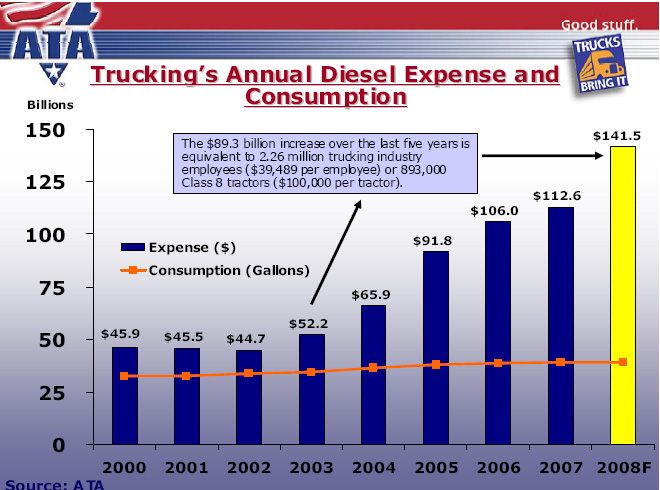
The trucking industry is on pace to spend an incredible $141.5 billion on fuel this year. This is $29 billion more than we spent in 2007, and more than double the amount we spent just four years ago.

Click Here to See Reader Feedback

While shippers ultimately pay the price, the rapidly escalating price of oil and diesel fuel costs have created what the American Trucking Association, an industry trade group, calls a “fuel price crisis,” with calls to Congress for a multi-pronged program to move fuel costs the other direction.

Last week, Mike Card, State Vice President for the ATA and also President of Combined Transport, a small trucking company in Oregon, testified before the U.S. House of Representatives Subcommittee on Highways and Transit about the impact of rising fuel on truckers and shippers and what can be done about it.

We all understand the impact these wildly increasing costs are having on the entire logistics industry, but sometimes it’s good to take a pause to really consider the numbers.

“The trucking industry is on pace to spend an incredible $141.5 billion on fuel this year. This is $29 billion more than we spent in 2007, and more than double the amount we spent just four years ago,” Card told the sub-committee.

The costs are not only adding tremendously to the cost of transportation, but taking a toll on trucking operators themselves. Card said that in the first quarter of 2008, 935 trucking companies with at least five trucks failed - the largest number of trucking-related failures since the third quarter of 2001. He also said that it is very likely that a large number of companies that operate fewer than 5 trucks also failed during the first quarter of this year.

While some of these failures are also attributable to the slowdown in freight movement, the punishing costs of fuel, for which fuel surcharges can no longer seem to keep up, is certainly a factor. Amazing to many, for most truckers, fuel now exceeds labor costs as the top operating expense.

(Transportation Management Article - Continued Below)


Category Sponsor:


The ATA Proposal

In his testimony, Card outlined the ATA’s proposals for both reducing demand for fuel as well as increasing supply, which it hopes will change the supply-demand balance and lower fuel costs. (A full transcript of Card’s testimony is available here: Mike Card Testimony before Subcommittee on Highways and Transit.)

Ideas to reduce demand:

  • Control Speed: Cap highway speeds at 65 MPH and strictly enforce at the state level for all vehicles; add electronic devices to trucks to prevent them from exceeding 68 MPH.
  • Reduce Main Engine Idling: There are barriers to carrier adoption of Auxiliary Power Units (APUs) to eliminate the need to idle when truckers are resting. The ATA calls for states to waive certain truck weight limitations for adding these devices (otherwise, a truck can carry less cargo), to eliminate the current 12% federal excise tax on these units, and to provide financial incentives to truckers to purchase APUs.
  • Address Congestion and Highway Infrastructure Issues: Truckers and non-truckers burn tremendous amounts of fuel sitting in traffic or moving very slowly due to congestion. The ATA recommends that Congress invest in a new congestion reduction program to eliminate major traffic bottlenecks, with a specific focus on bottlenecks that have the greatest impact on truck traffic. That action could save as much as 32 billion gallons of fuel over 10 years.
  • Fully Fund the EPA’s SmartWays Program: This highly successful program that incents carriers and shippers to reduce fuel usage actually saw its funding cut by 33% in the current fiscal year.
  • Enhance Truck Productivity: Not clear exactly, but it appears this relates to more flexibility in using trucks hauling two or even three trailers. Card said a recent study by the American Transportation Research Institute found that use of these vehicles could reduce fuel usage by up to 39%, with similar reductions in criteria and greenhouse gas emissions.
  • Regulate Petroleum Exchanges: Congress should consider the merits of expanding government oversight of electronic petroleum exchanges to make it less attractive for hedge funds to speculate on petroleum prices, while ensuring that a robust market exists for legitimate purposes.

Ideas to increase oil/duel supply:

  • Increase Domestic Exploration: In Alaska, off various coasts, tar sands, etc.
  • Increase US Refining Capacity: Streamline the process for expanding or building refining facilities.
  • Enact a Sensible Approach to Renewable Fuels: Invest smartly, and stop some of the silliness. For example (news to us too) Card said: “We believe that the American public would be outraged if they knew that their tax dollars were being spent to subsidize biodiesel that is ultimately exported for sale outside the U.S.
  • Adopt One National Diesel Fuel Standard: Stop the state level “boutique” fuel standards, which add refining constraints and costs.
  • Stop Filling the Strategic Petroleum Reserve: Temporary changes to the program could drive speculators out of the market.

Whether you agree or disagree, it’s a well-considered list. Not much word yet on Congress’ reaction.

What’s your reaction to Card's testimony, and the ATA recommendations? What would you do to increase supply or to reduce demand? Let us know your thoughts at the Feedback button below.


Send an Email


Feedback

May 14, 2008

It is truly crisis time for the logistics industry and practice as well as the broader economy.

I do not think many of us are even really seeing the big picture of what is happening.

I applaud the ATA and Card for their recommendations. They will not solve everything, but they are real, practical steps that can be taken right now.

What are we waiting for?

Steve Carty
Medina, OH


May 14, 2008

I salute the ideas od Mr. Card to reduce consumption (demand) and increase the supply of diesel, economics 101 says this will cause prices to fall.


I think it is crazy to be filling the Strategic Petroleum Reserve at this time.  The Feds just increased the target for reserves from a lower level which keeps the USA pumping more and more oil into the reserve.


Vehicle productivity: we have the opportunity in 2009 through the Federal Highway Bill reauthorization to remove the FHB moratorium from 1991 that prohibits states from increasing the length or weight limits for trucks.  Not only should states be allowed to decide if tandem or triple trailers should be legal on certain roads, the states should also be allowed to decide if maximum weight limits should rise:  97,000 pound - 6 axle vehicles will produce the same axle weight limits as now, but up to 15% more efficient trucking for heavy loads.


U.S. Representative Oberstar (D) Minn. as chairman of the House Committee on Transportation and Infrastructure is the primary author of the 2009 Federal Highway Reauthorization Bill.  Everyone trucking executive should write or call him (and your own U.S. Senators and Representative) to express your opinions on this subject. The bill will not come up for reauthorization again until 2015.


Speak now or forever hold your peace.


Ken Allen

Supply Chain Executive

Texas


May 14, 2008

All good ideas that unfortunately do not address the main issue. Oil prices are going to continue going up as the oil reserves in our planet are going down. Remember the law of demand and supply? What about implementing incentives for our bright engineers to develop the next generation of truck engines?

1- a hybrid truck engine

2- an all electric truck engine

3- a hydrogen fuel cell truck engine

 Hernan Medina


Related Videos Related News & Videos
Coming soon
Supply Chain Comment: Should We Still Act as if Cheap Oil is a Thing of the Past?
Logistics News: It's Bye-Bye for DHL Parcel Operations in US Market
Global Logistics News: Was Ocean Shipping the Biggest Bubble of them All?
Logistics News: What are the Top Transportation Issues for Next Administration?
Logistics News: What Can You Do About Rising Shipping Costs
Logistics News: Shippers Should Avoid Over Optimism While Seeing Plummeting Oil Prices
   
Keywords
Logistics costs   Peak Oil   Transportation   Logistics costs   Peak Oil   Transportation


Supply Chain Digest Home | Contact Us | Advertise With Us | Sitemap
© 2006-2007 Supply Chain Digest - All Rights Reserved