RFID and Automatic Identification Article - Continued
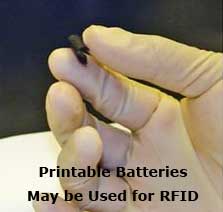 Understanding Printable Batteries Understanding Printable Batteries
The concept of a printable battery is related to an existing category called “thin film” batteries, which NanoMarkets says represent about 3% of the current RFID and “smart packaging” battery market. The vast majority of RFID tags use button batteries, which are typically several millimeters in height. Thin film batteries are only about 1 millimeter high.
The report says that there is likely to be a merger of current thin film and printable battery technologies. Printed batteries are at the moment characterized by printed electrodes. Most printed batteries now use a liquid electrolyte applied after the electrodes are “printed” on the substrate. However, should the industry develop one of several solid-state electrolyte inks under development, these batteries could become entirely printed, the report says.
The attraction – in part, lower costs: “While most thin-film batteries are manufactured today using standard (and often expensive) semiconductor deposition and lithographic techniques, printed batteries could eventually be manufactured using far less expensive printing methods,” the report states.
Printed batteries at least in theory can also be printed in almost any size and shape, and applied to flexible substrates making them easy to integrate into emerging flexible electronics products, packaging and notably flexible displays. There are also needs for batteries that have sufficient power density, yet are packaged in a small format, with long periods between charges, attributes which printed batteries may be able to achieve. Printed batteries should also be more environmentally friendly at end-of-life than button batteries.
Though there will be many potential applications for printable battery technology, NanoMarkets’ analysts predict that RFID will represent the largest potential market for thin-film batteries thanks to the need for low-cost active, or hybrid (semi-passive) RFID tags with longer ranges compared to non-powered passive RFID tags. Although their cost prohibits them from being used with low-cost commodity goods, such as food and other staples, the retail sector is expected to use powered RFID for higher-margin goods where security and loss is a greater issue.
To reach this potential, the technology still needs to develop, but the researchers believe current efforts should lead to substantial improvements over the next few years.
Do you see advantages to “printable” batteries for active and semi-passive RFID tags? How so? What are the technical challenges? Let us know your thoughts at the Feedback button below. |



 RFID and Automatic Identification Focus: Our Weekly Feature Article on Topics of Interest to those Using or Considering RFID or other Auo ID Technologies
 To reach this potential, the technology still needs to develop, but the researchers believe current efforts should lead to substantial improvements over the next few years.