| November
11, 2004 |
 |
|

|
 |
|
|
|
   |
 |
|
| |
Dan Gilmore
Editor-in-Chief |
|
|
|
Strong
rumors floating around this week that another so called
International Trade Logistics (ITL) vendor was basically
closing up shop and putting its assets up for sale.
Unable to get absolute confirmation of the facts, and
I’ll keep the company nameless for now, but when
you can’t get a human being on the phone no matter
what you try, I think the rumors have some credence.
So, outside the handful of customers that use this vendor’s
solution, should the rest of us care? I actually think
so, as it relates to some issues around international
logistics, and the state of automation and technology
to support it. With a large number of SCDigest readers
concerned with global trade and logistics, I thought
it was worth a few lines.
Just for clarity, traditional ITL vendors are focused
on automating compliance and regulatory processes for
import/export based on rules-oriented systems and “content”
– the country specific information, encoded in
the software, concerning denied parties, what countries
can be shipped what goods, duties and tariffs, export
documentation, etc. Of late, the category has been blurred
with vendors offering visibility, event management,
transportation booking and related solutions/services.
Given the explosive growth in global trade, it seems
like these should be boom times for such vendors, but
alas, it is not so. Arzoon – sold off at fire
sale prices to SSA. Qiva – ditto to Trade Beam.
Clear Cross – gone somewhere I can’t even
find. Most of the rest – not exactly knocking
the financial cover off the ball.
So is the problem that there is no problem - global
logistics and trade management is working just fine
for most companies, thank you very much? Or is it something
else?
To get some insight, I first spoke to Stephen Craig
of CP Consulting, a real expert in international logistics
issues, who observes that for most companies, there
just aren’t that many people tied up in regulatory/compliance
related work, making cost justification for automation
difficult. He also notes that the specter of government
penalties for non-compliance is perhaps not as draconian
as the vendor marketing may claim, especially if any
mistakes are made in good faith.
Joe Broderick, former CEO of Qiva, seconded those thoughts
by commenting that pure regulatory and denied party
solutions were “something of an insurance sale.
You’re selling on the fear of fines, penalties
and bad PR.” He also noted that really onerous
security regulations coming out of expected Homeland
Security changes have never really materialized, failing
to give the market a needed shot in the arm.
All good points. And yet, the reality is that for most
companies, international trade and logistics remains
relatively if not largely unautomated. I recently met
with the manager of a multi-billion dollar manufacturer
who told me his company is basically blind to what’s
happening in international movements until it hits the
port here in the U.S. In our “How
to Select a TMS” web seminar earlier this
year, we heard how Flextronix needed to put together
solutions from several vendors plus a little custom
build to meet their international needs.
I often hear complaints that no vendor has really delivered
a world class, integrated global logistics solution.
Vendors like GLOG and GT Nexus are moving in the right
direction. Less known players such as Blinco Systems
and Trade Beam have put together interesting and differentiated
solutions, both with a strong (though different) financials
element.
So, is it a market problem – these solutions really
just aren’t much needed? Or is it a vendor issue
– a problem waiting for the right set of capabilities
and value prop? As always a little of both, I suspect
…but I still think we have a long way to go to
get international trade and logistics processes and
technology right – and have seen the results some
companies have achieved from their process and technology
improvements.
Why isn’t the market bigger for “ITL”
solutions? Do you agree most companies still have a
long way to go to automate and improve global logistics
processes? Should you just outsource it all to UPS?
Let us know your thoughts.

|
|
|
 |
|
|
 |
| |
|
 |
|
| |
Speaking of international trade and global logistics,
what are the world’s top five exporting
countries by merchandise value?
Answer
below |
|
|
 |
|
|
Feedback
is coming in at a rate greater than we can publish
it – thanks for your response.
A few issues ago, our SCDigest trivia question
posed this problem: Assuming a single tier network,
a fixed level of demand, and all the same DC capacity,
at what number of facilities will you double the
total network inventory versus one central DC?
The answer: with the fourth DC, you will double
total network inventory, according to The Supply
Chain Handbook from Tompkins Associates.
Below, you’ll find our Feedback of the Week
from Hugh Walters of Tyson, who puts some additional
thought and nuance to this whole topic. We know
you’ll enjoy his letter – and we would
welcome feedback from other experts on this whole
topic!
For
more complete comments from readers, click
here.
Keep
the dialog going! Give us your thoughts on this
week's Supply Chain topics.
feedback@scdigest.com |
|
|
|
|
| |
|
|
View
Full Article >>
Short but thoughtful
article from Mercer Management on understanding the
profitability of different channels. As the column begins:
“Executives at firms that sell to other businesses
often assume that their largest channel partners, be
they retailers, industrial distributors, or some other
type of channel, are their most important and profitable
ones. But in fact, larger channel partners often will
generate little or even negative profits. Meanwhile,
smaller customers with higher profitability and more
potential may be starved for attention and resources.”
Part of the problem, of course, is that companies struggle
with systems that enable them to accurately assess true
customer/channel profitability. Accurate assessment
of true supply chain and logistics costs is a big part
of the information deficit, as are costs associated
with promotions, financing, receivables, etc.
Mercer suggests such an analysis will cause many to
find that many channels are really money losers, not
money makers, as the example below shows.
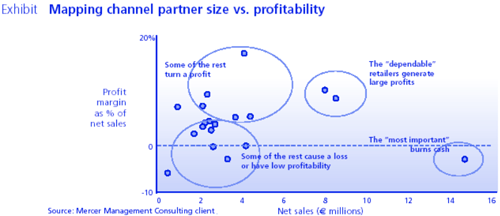
Using this profitability as one filter, a company can
then also add the dimension of what the growth opportunities
are through each channel. The result (as seems inevitable)
is a four-quadrant matrix, with these types:
 |
Red ink partners,
those that are becoming larger and are unprofitable
or have below average profitability, constitute
a major barrier to growth. A supplier must turn
the red ink to black or muster the fortitude to
decrease business with these partners. |
| Re-purpose partners,
which are unprofitable or have below-average profitability
but are stagnant or shrinking, may not be quite
as pressing a problem. Still, resources should
be diverted. |
| Stalled partners are the profitable
accounts with low or below-average growth. A supplier
needs to jump-start their stalled business in order
to create more growth and more value. |
| Next generation partners are profitable
and growing––everything you could ask
for in an account. The question now becomes, what
might the next generation of growth with these rare
and valued partners require from the supplier? |
Accepting that in fact such an analysis will often provide
a similar type of result, the challenge is whether a
company really should – or has the intestinal
fortitude – to get tough or ramp down business
with the large, unprofitable channel partners. Having
been involved in a few of these analyses, one huge challenge
I’ve found is that the large accounts often absorb
a tremendous amount of manufacturing and administrative
overhead. And with Wall Street generally punishing companies
for problems with the top line, managing the transition
of revenue from the large unprofitables to the fast
growing profitables is risky business – which
is why so few dare to do it.
Are large channel partners often unprofitable? Do companies
have the tools to measure that accurately, including
supply chain costs? Even with the information, how many
companies really have the guts to make the switches?
Let us know your thoughts.

|
 |
 |
|
|
Article in the Wall Street Journal
a few weeks ago about how the battle to gain shelf space
and market share in the fiercely competitive retail
environment is causing CPG companies to spend even more
money on store-related promotions.
The article notes the moves are almost the inevitable
result of the amount of SKUs that retailers and customers
must deal with – 100,000 items or more in large
superstores. Getting new products on a fixed amount
of shelf space – and getting consumer attention
in store, requires creativity – and major dollars.
The article cites research from Cannondale Associates
that says CPG companies increased their spending on
in-store promotions to 17.4% of sales, from 14% in 1999
– versus 5-10% of revenue for traditional advertising.
51% of laundry detergent and 75% of beverages were sold
on promotion last year. Kraft recently announced plans
to spend an extra $600 million on in-store promotions.
Some of the money is going to flashy in-store displays
– which often have major supply chain/logistics
implications. When P&G, for example, launched its
new version of Downy, it did so with displays that included
pillows, posters and balloons. Nestle designed a special
container for its bottled water exclusively for a large
European grocer.
The article notes the continued growth in spending just
to secure shelf space (so called slotting allowances),
some of which is retailer profit driven, some of it
simply as a means to allocate a fixed amount of space.
As one expert notes: “Nobody wants to spend more
money, but everyone is afraid to spend less.”
In-store promotions cause many supply chain challenges:
demand planning and forecasting, spawning in part a
new concept/technology of “trade promotions management.”
End of aisle and other in-store displays can wreak havoc
on distribution operations – and replenishment
to the store and from the back room to the shelf is
obviously a challenge (RFID to the rescue).
As always with WSJ articles, I can’t copy a link
directly, but let us know if you would like a copy of
the article via the feedback button.
Is there any end to the in-store promotions activity
and spend? What kind of challenges do you think this
puts on forecasting, replenishment and distribution
systems – and can companies well manage those
challenges today? Let us know your thoughts.
|
|
|
|
|
View
Full Article >>
Short note from the MIT Technology
Review daily newsletter that points out that the use
of RFID for tracking of humans – not just cartons
to Wal-Mart and the DoD – is actually here.
The piece cites the use of RFID-based wristbands by
a New York hospital to encode patient data and reduce
the possibilities of wrongly administered drugs. As
the use of even bar coding to reduce such errors is
way overdue, we think this is a good thing.
News to us was that Paramount’s Great American
Amusement Park in California is offering an option to
purchase RFID wristbands for $5.00 each. Wristband purchasers
will have their movements proactively monitored by a
network of 65 antennas around the park - the service
is geared at parents who want to easily be able to find
children who wander away.
The use of the technology in this way is sparking the
usual privacy concerns.
Anyone who thinks in 10 years or so our bosses (or maybe
spouses) won’t be able to know exactly where we
are at all times, please dial home.
These seem like great applications for RFID… but
do the privacy advocates have some point about where
all this could be going? Do we need some form of regulatory
protection? Let us know your thoughts.
|
|
|
|
|
| |
|
|
|
My understanding of the square root rule, which is what
appears to be referenced here, is that it applies to
safety stock and not cycle stock. Thus, in the case
of a fixed level of demand (constant, non-varying rate
of demand) there may be no increase in network inventory.
Theoretically, there could be a decrease in network
inventory if supply lead times were decreased because
of improved placement of DC's.
Fortunately, there is always uncertainty in demand because
this is what keeps me employed. The level of uncertainty
results in various quantities of safety stock based
on order fulfillment policies. A qualitative example
may best illustrate the answer given inappropriately
uses square root rule.
Case 1: Product demand in a single DC network averages
1000 units per week with a standard deviation of 5 units
per week.
The order fulfillment policy requires a high service
level and 15 additional units are maintained in the
warehouse. The fifteen extra units is three times the
weekly standard deviation of demand. Replenishment takes
one week. Thus, 1000 units are ordered every week. This
leaves an average network inventory of around 1515 because
I always have 1000 units (on average) in the pipeline
and 515 units (on average because it is consumed through
week) in the warehouse every week.
Case 2: The same product demand from Case 1 is split
evenly between four warehouses so that each warehouse
experiences an average weekly demand of 250 units. Unfortunately,
the standard deviation of demand for each warehouse
cannot be determined without some data. However, a reasonable
estimate is an unchanged standard deviation of 5 units
per week. This is statistically possible because the
interaction between demand regions may cancel each other
when aggregated in one warehouse as opposed to four.
Keeping the same high service policy, 265 units are
maintained in each warehouse. Keeping replenishment
fixed at one week, four orders of approximately 250
units each are placed every week.
Therefore, the average pipeline inventory remains unchanged
at 1000 units per week and each warehouse has an average
inventory of about 140 units per week. The total network
inventory is 1560 units.
I hope this illustrates the point that inventory would
not double to 3000 units per week as your answer implies.
For this to happen, demand variability would have to
be large relative to average demand. In this case, network
inventory only increases 3%. Additionally, safety stock
did not double ... it went up threefold.
Since this rule is often misinterpreted and based on
some simplistic assumptions it is one of my least favorite
supply chain rules. I only use it when I have no data,
no calculator, and no time.
Hope this helps
Hugh P. Walters
Tyson
|
|
|
|
|
|
| © Copyright 2004, SupplyChainDigest. All rights reserved. |