| September
16, 2004 |
 |
|

|
 |
|
|
|
   |
 |
|
| |
Dan Gilmore
Editor-in-Chief |
|
|
|
At a recent
event for technology vendors sponsored by AMR Research,
the question was raised about “what would make
a perfect software vendor” from a customer perspective.
I’ve been thinking about that question, especially
as there was far from any consensus at that gathering
as to what that vendor would look like. To be meaningful,
the characteristics of the perfect vendor would have
to be realistic, meaning it can’t include things
like “give us everything for free.” But
that said, I have a few thoughts across a variety of
dimensions.
We’ll start with a company’s goal when buying
the software to begin with: results and value. I was
talking to a friend at the AMR event, and we agreed
that the “perfect” software vendor would
have built a solution that started to provide “instant
returns” from its deployment. This means that
the buying company starts to achieve improvements in
profits and cash flow almost literally from the day
the software is turned on.
This is actually a big difference from many software
applications, for which (of course) a strong ROI estimate
can be built, based on improvements over time. But even
when that time frame is as short as a year, how often
does a company start putting money back in its pocket
from day 1 after go-live? The reality is rarely, though
there are some exceptions (more on this in a future
column).
I think a perfect vendor would combine both its solution
and expertise to accelerate this “time to value”
to enable immediate returns.
What else would characterize our perfect vendor?
Now, I well understand the practical business and technology
challenges that make it difficult for any vendor to
achieve “perfect” status. I also strongly
believe that even the “perfect” software
vendor would not be able to achieve any thing like perfect
customer satisfaction ratings – there just seems
to be an inherent amount of dissatisfaction with software
that no one will ever eliminate.
Nonetheless, I think we could also agree that many vendors
have some ample room to move between where they are
at and some notion of perfect. And buyers should be
thinking this way when making evaluations across different
vendors.
What do you think would make a “perfect”
supply chain software vendor? Should more supply chain
software providers focus on providing clear, immediate
improvements in profits/cash flow from their deployment?
Let
us know your thoughts.
|
|

|
|
|
 |
|
| |
What percent of cereal and cookie giant Kellogg’s
sales come from Wal-Mart?
Answer
below
|
|
|
 |
|
|
Feedback
is coming in at a rate greater than we can publish
it – thanks for your response.
We received
dozens of responses – in fact, probably
our most ever - from our First Thoughts piece
two weeks ago on “Re-stapling yourself to
an order.” Many were short and sweet –
we’ve collected a sample of them below.
We also have our Feedback of the Week on this
topic from David Hawkins of Miller Brewing, who
has some interesting comments about modeling the
order cycle process.
For more complete comments
from readers, click here.
Keep the dialog going! Give us your
thoughts on this week's Supply Chain topics.
feedback@scdigest.com
|
|
|
|
|
| |
|
|
View
Full Article >>
Interesting
article from consultant Booz Allen’s in-house
publication on the opportunities for what it calls the
“advantaged supply network,” a concept we’ll
summarize as combining strategic sourcing and supplier
design collaboration principles. It’s a story
that’s been told many times before, but rather
well here again.
In summary, manufacturers focused on bidding out virtually
every piece and component in an effort to continuously
drive down costs and beat industry benchmarks for component
costs may lose all those savings and a lot more from
a loss of total supply chain efficiency. (See graphic
below).
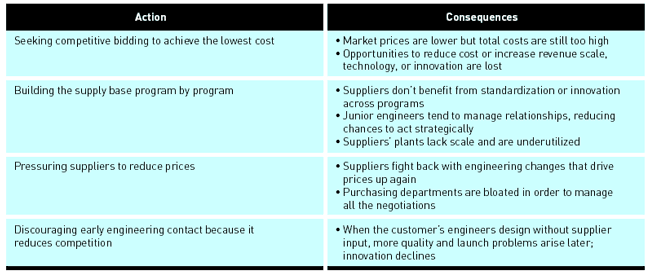
Source: Booz Allen
By moving to a model that uses fewer suppliers, shares
a variety of strategic and tactical information much
more widely, and encourages manufacturers and suppliers
to look at reducing total supply chain costs, system
wide savings can often be much greater than the incremental
reductions in per piece costs. As the article states: “We believe executives struggle, in part, because
when they concentrate on “piece part” prices,
they overlook the millions of dollars in potential costs
generated by the constant one-upmanship inherent in
the traditional bidding process — the rounds of
post-auction engineering changes that drive low prices
back up, supplier bankruptcies, late deliveries, and
other fallouts associated with a management process
that encourages supplier turnover. Moreover, because
buyers and suppliers are so intent on getting the price
right, they don’t examine or sufficiently communicate
with each other about such other significant sourcing
and production variables as design, faster time to
market,
quality, and innovation, which are all crucial to supply-based
competitiveness.”
Sure, sounds great. How do you get there? In very short
summary:
More details in the article. You may have to register
to get access.
I don’t think there is any doubt many if not most
companies have opportunities to reduce costs through
more strategic sourcing and collaboration, and that
changing those internal paradigms is a gut-wrenching
transformation that requires incredibly strong senior
leadership. And while I also sometimes wonder if this
model at the extreme can’t perhaps lead to some
stagnation over time based on a lack of competition
between vendors, I also recognize the success Toyota
has enjoyed for many years using this approach with
no signs of letting up.
What does it take for companies to move from piece-oriented
procurement approaches to strategic sourcing and collaboration?
Is it a panacea – or are there downsides to moving
away from a highly competitive supplier environment?
Let us know your thoughts.

|
 |
 |
|
|
View
Full Article >>
We’ve published one or two interviews
with Wal-Mart CIO Linda Dillman on RFID before, and
now here is the latest one with Information Week magazine.
In this piece, Dillman puts some clarity around the
“killer app” for RFID from its perspective
– getting cartons from the back room to the store
shelf.
Dillman states: “When you shop Wal-Mart on a Saturday
afternoon, there's a pretty good chance many items aren't
on the shelf anymore. Associates do their best restocking
items, which is one of our biggest challenges. We know
when inventory comes into the building. We don't know
exactly where and when it needs to go from the backroom
to the shelf. We've looked at this 100 times in the
last 10 years. All the technology we reviewed would
put restrictions on our ability to move products around
the store and out to the customers.
“People have tried to handle that by locking down
the back room, which is process driven. We drive the
business on [such] a take-care-of-the-customer process
that I cannot fathom telling an associate they can't
get merchandise for a customer until someone is there
to check it out for them. We've struggled to concur
that.
“This is it. It works because stuff coming in
and out of the rooms is at case level. We know if it
goes to the floor, and then to the compactor, that we've
emptied the case. We can draw some conclusions about
what we have on the shelf versus what's in back, and
what's been sold that day. I can also draw conclusions
based on what the shelf holds. The shelf holds 24 [items],
and inventory says we have 20 [on the shelves] and I
know we have quantity in the back room. That inventory
should go on the shelf because it will fit.
“We know the quantity, but don't have a clue where
the merchandise is. If anyone has been in the back room
of a major retailer at Christmas, finding product can
be a daunting task. That really was the killer app.
And we don't have to have 100% reads. If I miss the
read to the floor, I get it coming back from the floor
and then to the compactor. “
Though I am sure Bentonville would disagree, this is
actually the clearest explanation of Wal-Mart’s
initiative that I have heard, as the reasons and justification
have clearly shifted over time, at least publicly. And
no one will dispute the challenge retailers have with
shelf-level out-of-stocks when the merchandise is really
in the back room.
Can RFID help solve this problem? Absolutely. Must it
be RFID that solves it, given the enormous investment
by all concerned? That is much less clear, especially
since EPC technology won’t really tell Wal-Mart
exactly where all those cartons are in the back room
at Christmas. Why Wal-Mart can’t get use all those
Symbol handhelds and bar codes to accomplish this is
still a bit of a mystery to me and many others. As we’ve
said before, scanning appears to be just too darn hard.
Now that the problem is clearly identified, is EPC
clearly the right way to solve it? Am I the only one
that thinks
Wal-Mart’s public statements have shifted a bit
over time? Let us know your thoughts (will respect
confidence
if requested as always).
|
|
|
|
|
View
Full Article >>
It’s only marginally about supply
chain, but BusinessWeek.com recently put together a
special section on where retail technology is headed,
and the one focused on the shopper’s in-store
experience supports other evidence that there really
is a lot going on. As the story notes, retailers should
get ready “for a makeover as dramatic as any on
the Mix It Up home-design TV show. Gone will be today's
cashier stations, price tags, paper sales signs, pharmacy
waits, and deli lines. Hold on to your cart, because
your shopping experience might soon have little resemblance
to anything you experience today.”
What’s happening? I’ll summarize it as cross
selling and self-service.
Retailers are focusing on a variety of in-store technologies
to push additional items on customers through improved
information. Information kiosks will not only help
customers locate tough to find items, but offer information
about complementary products (e.g., what window treatment
goes with the bed spread the customer is buying).
Stop
and Shop stores is among those piloting a “smart
cart” called the Shopping Buddy that provides
an electronic display of what the customer usually
buys,
allows them to make a trip specific shopping list,
and then provides location map for those products.
(I’m
now thinking we may need optimized “pick paths”
like we use in the warehouse!). The device can also
display recipes for tonight’s dinner and then
direct customers to all the right ingredients.
One possible cloud on the horizon: many of these technologies
are built on deep databases of individual customer’s
demographics and shopping habits, which may run into
more privacy concerns.
We can also expect to see an increase in spending on
self-checkouts, which, like self-service gasoline, offers
the promise of both increased customers satisfaction
from faster check-out while significantly reducing retailers
costs. In support of this in the grocery industry, IBM
is working on a scale that can visually identify produce,
even discriminating say between different types of apples
– no more worrying about what code to enter. RFID
of course will (someday) play a role here.
We have a lot of retail readers, many involved with
in-store issues, so thought this was worth sharing.
Will there be much impact on the supply chain operations
of either retailers or consumer goods manufacturers
from these coming changes? I’m not sure yet…we’d
love to hear your opinions.
How, if at all, will supply chains need to react to
support these “stores of the future”?
(Packing changes come to mind.) Let us know your
thoughts.
|
|
|
|
|
| |
|
|
|
I have analyzed and documented a number of different
types of processes including planning cycles and month-end-close
cycles. I find great truth in your comment that those
responsible for the processes often have the process
details and cycles quite wrong. From my perspective,
the ability of an organization to accurately understand
a process has two main drivers: (1) complexity of a
process, and (2) tools used to document the process.
The documentation is inevitably used to educate and
train those that use and rely on a process. It is very
hard to effectively convey process details using word
documents and excel spreadsheets. Advanced process modeling
techniques are required. Adoption of Use Case techniques
and UML modeling tools can go a long way to help organizations
understand and improve their processes.
David D. Hawkins
Miller Brewing Company
|
|
|
|
|
|
I think the premise is
very valuable. It could be turned into a corporate mantra
and many would benefit.
Glen M. Keysaw
Associated Food Stores
It is very eye opening to understand the total order
to cash cycle and many companies today have room for
improving the inefficiency of this process.
Mike Sobottka
Midwest of Cannonfalls
We
have used this process in the past. Sometimes incorporated
as a "brown paper" exercise (where you flow
out, with examples of all the process and steps the
order bumps along the way - making the process visible).
Steve Papke
Nestle
Just
the name of this article brings back lots of memories.
It's still true today and I think a re-read of the entire
article might be a worthwhile investment of everyone
in the supply chain's time.
Becky Shirley
Blitz USA
In
my 24 + years with Pennzoil, Pennzoil-Quaker State and
now Shell, I've been through implementations of at least
4 different order processing systems, numerous process
reengineering efforts, etc. While SKU counts and complexities
associated with customer demands have risen dramatically,
at the end of the day, some of the same basic service
levels in place 20 years ago are the same as today.
One can look at this from different perspectives. Had
we not invested in technology and ERP type solutions,
we would never achieve those same service levels with
the added complexity. The other perspective would be
that all that investment has resulted in no value. When
I really think about the difference in our business
today vs. those early years implementing that first
system, I'm convinced without those investments we would
not be close to staying at these levels.
Onward with RFID......
Don Hodde
Shell
I
do agree that whoever owns the order, owns the customer,
speaking as a customer myself. The better the experience,
the more likely I am to return to that company.
Robert T. (Rob) Hanson
Peels Salon Services
There
are a tremendous number of technological tools available
to companies today that were not available twelve
years
ago to assist in cutting down the quote to cash cycle
time. Leveraging the full power of those tools is
the
key to success – and the most difficult part
of the process.
Jane Kerr
ITT
It
is a very interesting subject and I am sure most manufacturing
companies with long cycle times have to deal with the
problem of late orders everyday. It would be interesting
to know if there is a study that shows the customer's
perspective. By this I mean quantifiable measures that
could be controlled by the customer like quantity of
orders, timing of order placement, sharing the demand
forecast with their suppliers etc and the impact some
of these factors would have on the supplier.
Raghavshyam Ramamurthy
Sappi Fine Paper North America
|
|
|
|
|
|
|
|
| © Copyright 2004, SupplyChainDigest. All rights reserved. |