Collaborative
transportation and hosted TMS solutions. Click here to
receive a free copy of our transportation metrics survey. www.shipperscommonwealth.com
Challenging WMS requirements? The industry's richest WMS
and logistics software solution is right here. www.softeon.com
You
Could Be Here!
Become a sponsor. It's easy! Use the "become a sponsor" button above to
contact us for details.
SupplyChainDigest’s
Quality Web Seminars
Insight and Education
January
28: How To Select a WMS
February
4: How To Select a TMS
The "No
Spin Zone" -
only from SCDigest!
Do Your
2004 Plans Include
Evaluating
a New WMS or TMS?
If so, you will not
want to miss these web seminars that will give you the
knowledge you need
to do the job right!
View More
Detailed Information on Both Events and Register Today!
Hours
of Service and TMS . What It Means To You
By
Robert Shagawat - President & CEO, Shippers
Commonwealth, LLC
There
have been several analyses (primarily from carriers)
and a lot of "noise" lately about the new Hours
Of Service starting January 4, 2004, as required
by new FMCSA government regulations in the U.S.
The
key changes in carrier operations are not well
known:
Increase in driving
hours from 10 hours to 11 hours.
Increase in mandatory
"off duty" rest from 8 hours to
10 hours.
Reduction in total work time
once coming "on duty" daily from
15 non-consecutive hours to 14 consecutive
hours.
All "off duty" time
less than 10 consecutive hours or two sleeper-berth
hours now accrues toward the 14 work hours,
as well as "on duty" and driving
time.
Drivers
will be permitted to "reset" their
weekly duty-hour clock once 34 consecutive
"off duty" hours have elapsed. In
short, drivers can drive an extra hour but
lose one hour of work time and must rest
two hours longer. Thus, the driver loses
approximately two hours or 8% (2/24ths)
of each "day" compared to old
rules.
Sometimes
(most of the time?), it's the simplest ideas that are
the best. I thought about this when the always entertaining
Art Mesher of Descartes Systems told a number of us
gathered at a recent media and analysts day, that most
of what you needed to know about your supply chain needs
could be found in answering a simple question: is your
supply chain long or short?
Long
supply chains typically involve complex inbound networks,
have a more global aspect, are characterized by long
lead and/or transit times, and involve many parties
in the process. Short supply chains obviously have rapid
order-to- delivery cycles, typically use regional distribution,
and involve significantly fewer parties to execute.
And
why should we care about restating the obvious? Well,
beyond the surface idea I'm not sure it is so obvious.
As Mesher noted, long and short supply chains have significantly
different characteristics, and thus very different process
and technology requirements.
Long
supply chains must have processes and tools to coordinate
dozens or hundreds of internal functions/sites, suppliers,
carriers and other service providers. They are more
subject to variability, one of the prime "enemies" of
low cost supply chains, since variability forces buffers
of inventory and time. "Visibility" and related data
quality and timeliness are key, and there must be tools
to manage these complex supply chain processes.
Short
supply chains can rely more on centralized control and
execution. Execution "precision" is required to meet
ever-shortening delivery expectations and "just-in-time"
inventory practices. And, as Mesher noted, companies
must manage trade-offs in "service policies" to both
reduce costs and/or gain market advantage.
The
reality, of course, is that many companies operate both
long and short supply chain processes. Sometimes, a
"long" supply chain is really a series of short supply
chains. But by thinking about different components of
your supply chain as being either "long" or "short,"
I think it is possible to create models that will help
your company to characterize its supply chain needs,
both in process and technology. They really are different.
I also wonder whether we will start to see more focus
on "service policy optimization," where we no longer
have one size fits all, but actively differentiate service
policies by channel, customer and even order, to maximize
total profitability. As just one of many examples, if
we could save $300 in transportation costs by combining
tomorrow's customer shipment with another the following
day, should we consider offering the customer some of
that savings to take delivery a day later than expected?
Is
it helpful to think about supply chains as being "long"
or "short?" What are the key differences? Is "service
policy optimization" something more companies will begin
to pursue? Let
us know your thoughts.
You'll also find a new feature nearby
today in SC Digest: "Consultant's Corner," in which we'll
highlight the thoughts of leading supply chain and logistics
thinkers on key issues of the day. This week's column
features Bob Shagawat of Shipper's Commonwealth, on the
impact of new carrier Hours of Service Rules and the role
of transportation management systems.
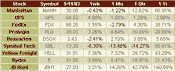
Logistics software, 3PL and transportation
stocks had a good week overall, with most stocks
in our index showing gains, led by Descartes
and Vastera, both of which have had a strong
past month as well. Manhattan, FedEx and UPS
were down 4%, 4% and 2% respectively.
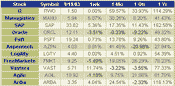
Supply
chain stocks were mostly up last week, led by
i2 which rose more than 20%. Logility was up more
than 10%, and most other stocks had strong gains.
Peoplesoft and FreeMarkets were the only stocks
in our index that were in negative territory.
On
average, how much (if at all) have average U.S.
ground transportation freight costs risen since
1990 on a cost per mile basis? Answer
below
Agree or disagree?
Have a perspective to
share with your peers?
Reader feedback from the topics in SupplyChainDigest
is growing every week! Keep the comments coming!
If you would like to keep your identity or company
anonymous, please let us know in your response.
We
had a few letters on our First Thoughts piece
last week on "Continued Pricing Pressures," including
our feedback of the week, from well known supply
guru Ed Marien of the University of Wisconsin.
Keep the dialog going!
Give us your thoughts on this week’s logistics
topics at feedback@scdigest.com.
NEWS AND VIEWS
GMA and FMI Jointly
Release Statement on Backhauling Best Practice View
full article>>
A
nice piece of work has recently come out of the Grocery
Manufacturers (GMA) and Food Marketing Institute (FMI),
which together recently issues a joint statement on
"Manufacturer and Distributor Customer Pick-Up/Backhauling"
issues.
While
obviously focused on the needs of the food/CPG to retail
supply chain, the report contains some thinking that
should be valuable to logistics organizations in any
industry that have the opportunity to collaborate on
transportation decisions with customers or suppliers.
In
the CPG-grocery supply chain, the retailers frequently
try to leverage assets (their own fleets or their carriers)
to pick up supplier shipments after making a store delivery.
The manufacturers in turn will offer an "allowance"
from the cost of goods (which includes delivered pricing)
for the retailer taking control of the load.
There
is more in this document than we can summarize here,
but some key recommendations are listed below:
Suppliers
should "unbundle" logistics costs into key components
(loading, line haul, unloading, other accessorials,
etc.)
Suppliers and
retailers should operate "open book" on transportation
costs to make the smartest transportation decisions
and drive down overall net landed costs.
Suppliers
should adopt standard rate structures on which to
base allowances: hundred weight, cube, pallet, percent
of invoice, etc.
Backhauling should
be discussed within an overall supply chain context,
and involve senior managers not just within the
transportation groups of each party.
This
is an excellent document that lays out the opportunities
- and by implication the challenges - of supply chain
collaboration. It is obviously directly related to the
robust discussions we had last year in SCDigest about
controlling inbound freight. Where the issue to me starts
to get thorny is in multi-stop truckload consolidation
- as it can turn into a "rubik's cube" of complexity
in terms of the total supply chain cost impact of a
customer picking up a partial load, which may cause
me to have to redo other multi-stop loads, etc.
But
for straight truckloads, the recommendations here make
a lot of sense. The report also notes that most companies
don't have the optimal technology to support this type
of collaboration robustly.
Do
shippers and customers need to make it easier to facilitate
customer pick-ups? Should "lowest total landed cost"
be the key metric in making this decision across parties?
Do we need new technology to make this work better?
Let us know your thoughts.
RFID Will Only Drive
Real Value If Companies Get Data Quality and Synchronization
Right, Says Article
At
least one thing about RFID is clear - for the benefits
to really occur outside true "closed loop" systems,
there is a whole lot of standardization work that needs
to happen.
As
a recent article by Ard Jan Vethman and Jeff Hopkins
of Cap Gemini Ernst & Young points out that this
is especially true with regards to synchronization and
communication of "meta data" across supply chain partners
- the part/SKU numbers, production locations, etc. which
serialized RFID tags should reference when read.
As
most know, for example, today the consumer goods-retail
supply chain is still plagued by inaccurate product
data, especially around "UPC" numbers. According to
this article, as much as 30% of such product data in
a retailer's system regarding their suppliers' products
is inaccurate or outdated.
As
the article notes, the RFID promise of automated tracking
with much less human intervention involved in traditional
bar code scanning can only be achieved if the referential
data is right. "To do this quickly and efficiently,
thereby realizing the improvements in receiving time,
the tag information must correspond with the information
in the retailer's systems. The product number must be
known and all corresponding attributes should be reliable,
as there is no human being involved any more to check
on simple things such as, 'Does my box say what I expect
it to say?' In many cases, human intervention is essential
to find out, for example, that the product delivered
under a certain code was not exactly what was expected,
or has different attributes."
In
the consumer goods-retail chain, for years we have independent
solutions (QRS, Wal-Mart's Retail Link). More recently
the UCC-sponsored UCCNet has emerged, and a parallel
initiative around "Global Data Synchronization," both
of which seems to be gaining traction of late. The EPCglobal
organization, in turn (now also part of the UCC), has
offered the Object Naming Service (ONS) and Physical
Mark-Up Language to address these data synchronization
issues. Many companies, of course, in all industries
use EDI or other proprietary means of keeping data in
sync between partners.
The
finalization and implementation of the EPCglobal standards
are in the early stages, however. Readers will note
that to start Wal-Mart is using neither ONS or Physical
Mark-Up Language in its early RIFD initiatives.
As
the authors of this article point out, we need compatibility
within the GDS/UCCnet standards and the emerging standards
of EPCglobal. One would hope such compatibility would
be a "no brainer," given the obvious benefits and the
participation of many of the same companies in both
groups. But one never knows.
It's
also clear that many companies don't have their own
houses in order in terms of data quality and management
to internally take maximum use of RFID or to publish
this data to EPCglobal. Any RFID initiative should look
very hard at these data quality/synchronization issues.
Is the promise of RFID likely to be impaired by these
data synchronization issues? How do we ensure GDS and
RFID standards are compatible? Let us know your thoughts.
The
recent turmoil over the first U.S. reported case of
mad cow disease has generated many comments on how to
increase beef and overall food safety, and inevitably
to RFID. An article in InformationWeek nicely lays out
recent actions.
As
some will know, a number of years ago animal tracking
with RFID became among the first real applications discussed
and implemented using the technology - though deployment
was on a limited basis. In 2002, the state of Michigan
instituted a mandatory cow tagging program after a tuberculosis
scare among its herds. With this program, "A cow in
northern Michigan last year developed tuberculosis,
and, in just a few hours, the Michigan Sate Department
of Agriculture was able to figure out where the animal
was born and what other livestock it may have come in
contact with. As a result, other cattle that might have
been infected with TB were found and tested before they
could pass the disease along, possibly to humans."
It
probably won't make the majority of us who are meat
eaters happy to know that today most cattle tracking
is performed with human readable metal tags, used by
forcing the cows through narrow passageways, so that
people can try to scribble the bovine ID numbers on
tracking forms. I've done some work with a WMS vendor
on "chokepoint" applications for RFID technology in
the warehouse - I guess this is the beef industry parallel.
This
seems one of those cases where RFID makes incredible
sense: you can't really use bar codes on livestock,
farmers aren't going to easily have database support
for using simple license plate type identifiers, the
cost in relation to the value seems pretty small. I
also think overall we need more of these specialized
applications to develop to help the technology and understanding
mature so that it can migrate into more general purpose
applications.
There
are the usual questions to making it happen in the meat
industry: who will pay for it (of course), developing
the technology infrastucture, what data should be on
the tag or put into a database. Interestingly, the article
also discusses a system that uses RFID tags to track
livestock birth through the slaughterhouse - where the
data is then cross referenced to a bar code-based system
as the product is packaged for retail.
As
we've said all along, we'll see bar code and RFID "co-existence"
for a long time.
Do
we need RFID tracking of beef and other livestock? Will
these specialized applications help drive the technology
into the overall supply chain? Let us know your thoughts.
FEEDBACK
(Continued)
Feedback
of the week - on
"Will the relentless cost/pricing pressure continue?
I
enjoy reading SCDigest and gaining the insights that
are offered.
Regarding
cost/price pressures: What costs are relevant?
As we review in our UW Executive Education programs,
different costing and pricing analyses are appropriate
depending upon the commodities and supplier/buyer relationships.
Costs can proceed from:
Cost
equal to the price of the good or service at the
supplier's facility.
Delivered costs including order admin
and transportation/logistics to the buyer's dock
or to an inside delivery point of sale or use.
Total Costs of Ownership,
TCO as this approach is called, when
you include inventory deployment carrying costs.
Return on Investment earning power
analysis as the buyer begins to analyze the effect
of the balance sheet on "best solutions."
The Dupont Formula is a great tool to investigate
the cost impact of various sourcing/make/fulfillment
strategies that go beyond "margins."
Total Life Cycle costing as you begin
to analyze many capitalized goods that have multi-year
usage including not only initial costs
and investments but sustaining costs of usage.
Related to 5 is environmental sustainability
cost impacts, as related to disposal/recycling of
main products, wastes and packaging/unitizing materials.
Finally,
the next Frontier is "Inter-enterprise SC
Economics," as firms begin to look at the
Value-Add of the SC network trading partners in
serving final end users of consumers. It
is not unusual that some goods, such as facial
tissues, have Inter-enterprise SC Costs that are
35% of the Price paid by the ultimate end users.
The European tax system for VAT is an excellent
inter-enterprise model to begin to identify Total
SCM financial metrics.
Keep
up the good work.
Dr.
Edward J. Marien
Prof
& Program Dir, SCM Programs
University
of Wisconsin
More
on cost pressures:
The
one area where the cost/pricing pressure is directly
going in the opposite direction---upward --is domestic
transportation. Momentum has been and continues to grow
as all significant true costs do in fact prove to be
going up at a rate which is NOT offset by the efficiencies
of operations etc... Although I am only partially involved
directly in the asset based world of motor carrier --it
is plain to see the facts. Higher insurance--with little
relief from the heightened potential of terrorist activities,
the increased costs of delayed border crossings
at the Canadian and Mexican points, the stiffer rules
and regulations and particularly the fresh new year
Hours Of Service rules --and most significantly the
simple fact that demand continues to outstrip supply---who
is advocating to their children to join the
truck driver workforce!!
As
for rail---well as most of us know they have us were
they want us and they often are fully capable of achieving
exactly what they want --and with the above scenario
painted--we have little alternative---but rather the
"driver" to abet the rails desires!!
Martin
Kelly
iWheels Logistics
On "So what does RFID really cost?":
The
50/45/5 case ratio (readers, tags, integration) for
case/pallet tagging is interesting. These numbers may
be reasonable if this is viewed as primarily an IT project,
possibly stopping after an operational pilot. From an
overall business perspective, I think the three-year
ratio might actually prove to be 25/15/20/30 (readers,
tags, integration, process changes). Included in readers
are costs for facility changes (e.g., portals at the
dock doors). Included in tags are the packaging-related
costs (e.g., corrugated materials with tags). Included
in the integration are both in-house systems (e.g.,
ERP) and trading partner systems. The real cost being
the reengineering of the business processes to get value
from the technology and integration. Without the business
process changes, you have RFID but lack the value provided
by RFID. There are many factors that can radically alter
the ratios, including the absence of an ERP/MRP system,
age/location of facilities, materials being tagged,
speeds & feeds, number of deployments, number of
form factors, quantity of cases/pallets, etc.
At
this point the industry tends to be working with simple
frameworks to get their hands around the costs. By the
end of next year we should have some generally agreed
to models tailored for the various drivers.
When
looking at costs, keep in mind that the value of the
tag should be relative to its functionality and its
value within the application. Like all investments,
it isn't the cost of the investment that's important;
it's the return-on-investment.
John
Klein
Klein
Consulting Group, LLC
SUPPLY
CHAIN TRIVIA ANSWER
Q.
On
average, how much (if at all) have average U.S.
ground transportation freight costs risen since
1990 on a cost per mile basis?
A.
Perhaps
surprisingly, according to Department of Transportation
Statistics, from 1990 to 2001 (the latest year
for which official statistics are available) freight
carrier revenue per ton-mile has risen only 9%
for trucking companies. Perhaps we should have
more sympathy for the carriers. But at least ground
carriers can feel better than their rail competition
- their revenue per ton-mile in 2001 was down
16% since 1990. Click
here if you are interested.